
Advanced Workflow: Multi-Step Process Orchestration for Business Central



Automate multi-step business processes in Microsoft Dynamics 365 Business Central—without writing code. Orchestrate task sequences, coordinate teams, track progress visually, and ensure nothing falls through the cracks. From employee onboarding to purchase approvals, inventory alerts to compliance workflows—Business Central workflow automation handles your most complex processes with simple configuration.
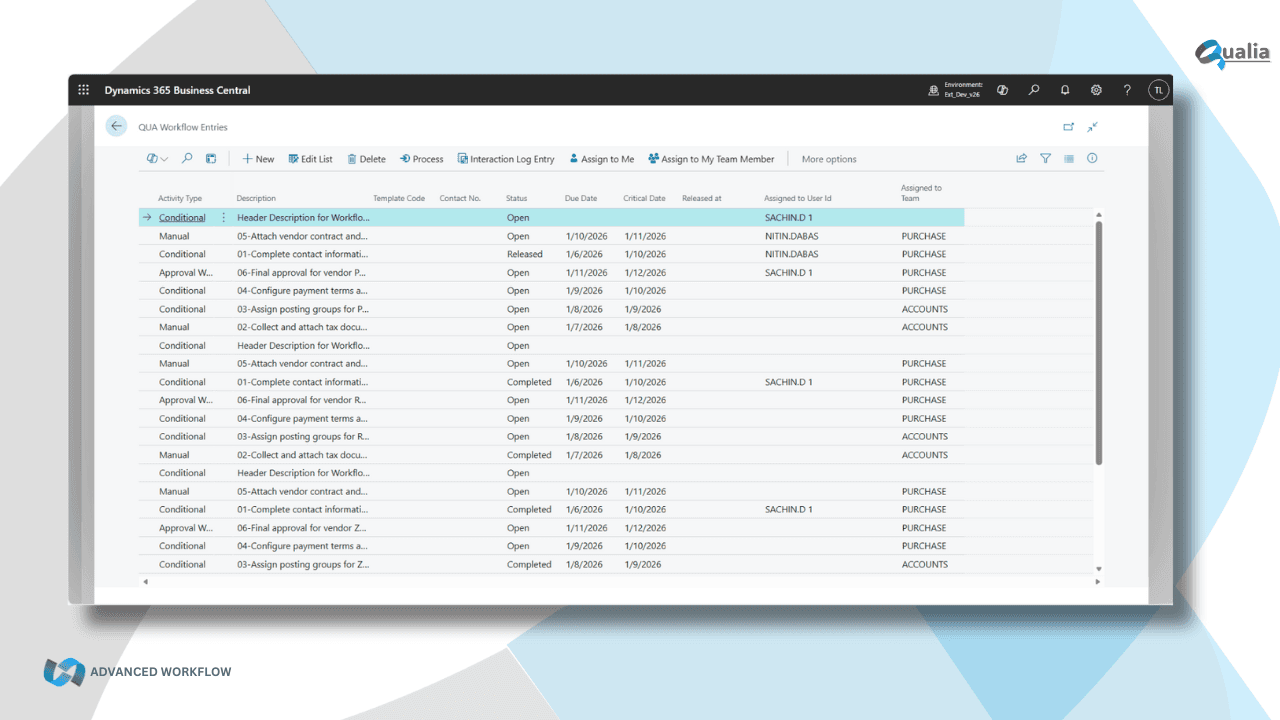
Business Central Advanced Work Flow | No-Code Multi-Step Process Automation
Automate multi-step business processes in Microsoft Dynamics 365 Business Central—without writing code. Orchestrate task sequences, coordinate teams, track progress visually, and ensure nothing falls through the cracks.
All-in-one solution: Includes the complete Business Rules engine (all 10 action types) built-in—no need to buy Business Rules separately—PLUS workflow orchestration, task management, and visual tracking.
Pricing: $15/user/month – Only users who work with workflows need licenses
✓ Verified Microsoft AppSource Publisher | ✓ Compatible with BC v14-v25 | ✓ 30-Day Money-Back Guarantee
Key Benefits
✓ Automate any multi-step process—onboarding, approvals, compliance, operations
✓ Visual workflow builder—define tasks, dependencies, escalations
✓ Built-in Business Rules engine—10 action types for validation and automation
✓ Real-time progress tracking and audit trail
✓ No coding required—business analysts can configure
✓ Works with all BC tables (standard, ISV, custom)
The Multi-Step Process Challenge
Business Central handles transactions brilliantly. But what about the processes around those transactions?
Employee onboarding requires 12 steps across HR, IT, and Finance—coordinated over 2 weeks. New vendor setup needs purchasing review, finance approval, IT configuration, and manager sign-off. Customer credit limit increases demand sales manager assessment, finance director approval, and AR team notification. Inventory replenishment triggers purchasing tasks, receiving verification, quality checks, and bin placement coordination.
These aren't single actions—they're orchestrated processes requiring:
Task sequencing: Step 2 can't start until Step 1 completes
Team coordination: Different people handle different steps
Progress visibility: Managers need to see where each process stands
Deadline tracking: Time-sensitive tasks need escalation if delayed
Audit trails: Compliance requires documentation of who did what when
Without automation, organizations rely on email chains, spreadsheets, manual follow-ups, and institutional knowledge. Tasks get forgotten. Processes stall. Nobody knows current status. Bottlenecks go undetected.
You need workflow automation—but enterprise workflow systems are complex, expensive, and require extensive IT configuration. You want BC-native task orchestration that business analysts can configure.
The Solution: Visual Multi-Step Process Automation
0-Code Advanced Work Flow brings comprehensive workflow automation to Business Central—orchestrating tasks, coordinating teams, tracking progress, and ensuring accountability across your most complex business processes.
Configure workflows visually through Business Central pages. Define task sequences, assign responsibilities, set dependencies, establish escalation rules. Watch processes execute automatically with real-time visibility into every task's status.
What You Can Automate
Onboarding & Setup Workflows
Employee onboarding: HR documentation → IT account setup → Equipment assignment → Training scheduling → Manager introduction → Payroll enrollment
Vendor setup: Purchasing review → Tax form collection → Payment terms negotiation → Finance approval → System configuration → First order placement
Customer onboarding: Credit application → Reference checks → Terms approval → Account setup → Sales territory assignment → Welcome communication
Operational Process Workflows
Inventory replenishment: Stock level alert → Purchasing review → Vendor selection → PO creation → Receiving verification → Quality check → Bin placement
Shipment preparation: Order allocation → Picking task → Quality inspection → Packing → Carrier booking → Documentation → Loading coordination
Service request handling: Request logging → Technician assignment → Parts ordering → Scheduling → Service execution → Quality verification → Customer follow-up
Approval Process Workflows
Purchase requisitions: Department manager review → Budget verification → Purchasing evaluation → Director approval → Vendor selection → PO generation
Credit limit increases: Sales manager recommendation → Credit report review → Finance analysis → Director approval → AR notification → Customer communication
Discount approvals: Sales rep request → Regional manager review → Pricing analysis → VP approval → Quote update → Customer notification
Capital expenditure: Department justification → Finance review → VP recommendation → Executive approval → Budget allocation → Procurement initiation
Notification & Alert Workflows
Customer credit monitoring: Credit threshold exceeded → Account manager alert → Finance notification → Hold order task → Customer contact → Resolution tracking
Quality issue escalation: Defect detection → Supervisor notification → Investigation task → Supplier contact → Corrective action → Management reporting
Aging inventory alerts: Stock age threshold → Purchasing notification → Review task → Disposition decision → Action execution → Accounting adjustment
Complex Multi-Step Workflows
Quote-to-order conversion: Quote approval → Legal review → Finance terms → Customer acceptance → Configuration verification → Production scheduling → Order creation
Return processing: Return authorization → Receiving task → Inspection → Disposition decision → Credit processing → Customer notification → Vendor claim (if applicable)
Month-end closing: Journal preparation → Department review → Reconciliation tasks → Adjustments → Manager approval → Final close → Reporting
Document & Compliance Workflows
Contract approval: Legal review → Compliance check → Finance approval → Executive signature → Document archival → Renewal scheduling
Audit response: Request reception → Document collection → Review tasks → Response preparation → Management approval → Submission → Follow-up tracking
Cross-Department Coordination
New product launch: R&D handoff → Manufacturing setup → Inventory planning → Pricing approval → Sales training → Marketing launch → Order activation
Location opening: Facilities setup → IT infrastructure → Inventory transfer → Staff hiring → System configuration → Licensing → Grand opening
All configured without coding—using Business Central's familiar interface and your existing BC data.
How Business Central Workflow Automation Works
1. Define Workflow Template
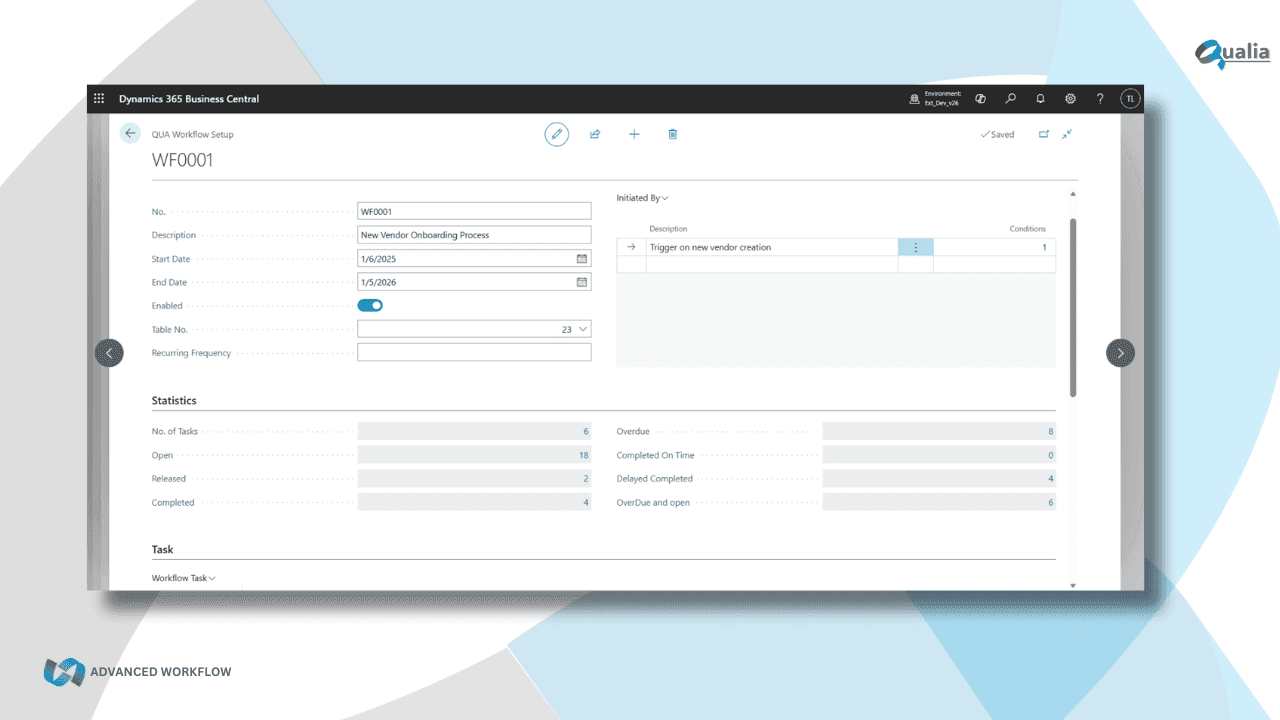
Create workflow template defining your process structure. Specify workflow name ("New Vendor Onboarding"), description, and which BC table triggers the workflow (Vendor table, OnInsert event). One template = one process type.
2. Configure Task Sequence
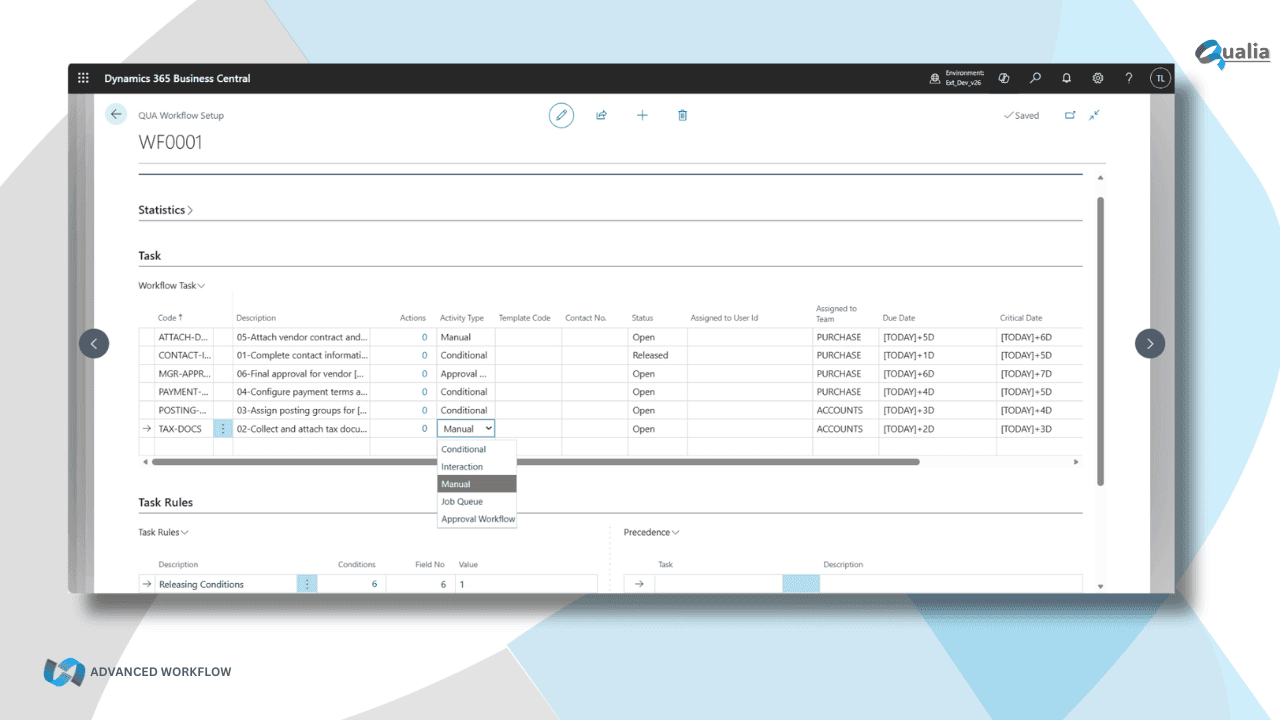
Add tasks in execution order:
Purchasing Review (assigned to Purchasing team)
Tax Form Collection (assigned to Compliance specialist)
Payment Terms Negotiation (assigned to Buyer)
Finance Approval (assigned to Finance Manager)
System Configuration (assigned to IT Administrator)
First Order Coordination (assigned to Purchasing Agent)
Each task has: Name, Description, Assigned User/Team, Due Date Formula (+2D, +1W, etc.), Priority level.
3. Set Task Dependencies
Define which tasks must complete before others start:
Tax Form Collection starts after Purchasing Review completes
Payment Terms Negotiation starts after Purchasing Review completes (parallel to Tax Form)
Finance Approval starts after BOTH Tax Form Collection AND Payment Terms complete
System Configuration starts after Finance Approval
First Order Coordination starts after System Configuration
Dependencies ensure proper sequencing—no task executes prematurely.
4. Configure Validation Rules
Leverage built-in Business Rules engine for task validation:
Finance Approval task requires "Payment Terms Code" populated before completion
System Configuration requires "Vendor Posting Group" assigned
Each task can have mandatory field checks, data validation, cross-table verification
Validation prevents incomplete task completion—ensuring data quality throughout the process.
5. Establish Escalation & Notifications
Set automatic escalation for overdue tasks:
Send reminder notification 1 day before due date
Escalate to manager if task remains incomplete 2 days after due date
Email task owner daily until completion
Configure task notifications:
Email assigned user when task becomes available
Notify team when high-priority task created
Alert manager when workflow completes or encounters issues
6. Activate & Monitor
Activate workflow template. From that point forward, workflows execute automatically when trigger conditions met (new vendor inserted, credit limit modified, inventory below reorder point).
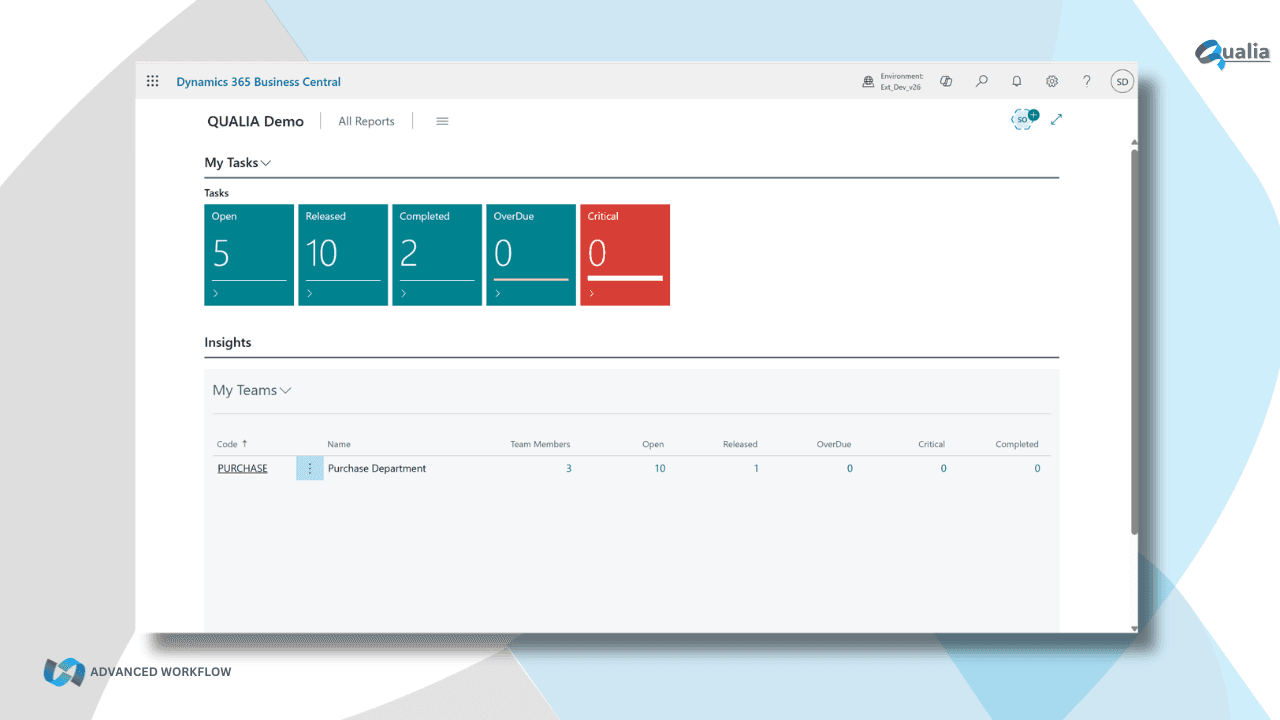
Monitor workflows visually through Workflow Instance page:
See all active workflows with current status
Drill into individual workflow to see task completion timeline
Identify bottlenecks (which tasks delay most workflows)
Track team workload (how many tasks each person has)
Review completed workflows for process improvement insights
Real-World Workflow Scenarios
Scenario 1: Employee Onboarding Workflow
Trigger: HR creates new employee record in Business Central
Automated Task Sequence:
HR Documentation (HR Specialist, Day 1): Complete employment paperwork, benefits enrollment forms, emergency contacts
IT Account Setup (IT Administrator, Day 1-2): Create network account, email, system access permissions
Equipment Assignment (IT Support, Day 2-3): Assign laptop, phone, access badge based on department
Training Scheduling (Training Coordinator, Day 3-5): Schedule role-specific training sessions, system onboarding
Manager Introduction (Department Manager, Day 5): First-day welcome meeting, team introductions, expectations discussion
Payroll Enrollment (Payroll Specialist, Day 5-7): Direct deposit setup, tax withholding, benefits deductions
Dependencies: Equipment assignment can't start until IT accounts exist. Manager introduction scheduled after training dates confirmed. Payroll enrollment requires all documentation complete.
Validations: IT task requires "Email Address" populated. Equipment task requires "Department Code" assigned. Payroll task requires "Bank Account No." entered.
Escalations: Any task overdue by 1 day escalates to department director. Critical tasks (IT, Payroll) get daily reminders.
Result: 12-step, 2-week onboarding process orchestrated automatically. New employee productive from day one. Zero tasks forgotten. Complete audit trail of who did what when.
Scenario 2: Purchase Requisition Approval Workflow
Trigger: Employee creates purchase requisition exceeding $1,000
Automated Task Sequence:
Department Manager Review (Manager, 1 day): Verify business justification, budget availability
Budget Verification (Finance Analyst, 1 day): Confirm budget line item has available funds
Purchasing Evaluation (Buyer, 2 days): Source vendors, negotiate pricing, evaluate options
Director Approval (Department Director, 1 day): Final authorization for expenditure
PO Generation (Purchasing Agent, 1 day): Create purchase order, send to approved vendor
Conditional Logic: If requisition > $10,000, add "VP Approval" task after Director Approval. If requisition for IT equipment, add "IT Standards Review" task before Purchasing Evaluation.
Validations: Purchasing Evaluation requires "Vendor No." selected and "Unit Cost" entered. Director Approval can only complete if Budget Verification passed.
Notifications: Email manager when requisition submitted. Alert director when their approval task available. Notify requester when PO generated or if rejected.
Result: Complex approval chain automated. Appropriate authority levels enforced. Budget compliance guaranteed. 5-day average requisition-to-PO time vs. 15 days manual process.
Scenario 3: Customer Credit Limit Increase Workflow
Trigger: Sales rep modifies customer credit limit to value exceeding current limit by >$5,000
Automated Task Sequence:
Sales Manager Assessment (Sales Manager, 1 day): Review sales history, payment behavior, relationship strength
Credit Report Review (Credit Analyst, 1 day): Pull credit report, analyze financial statements, assess risk
Finance Analysis (Finance Manager, 2 days): Review AR aging, payment patterns, calculate risk exposure
Director Approval (Finance Director, 1 day): Final authorization based on sales/credit/finance input
AR Notification (AR Specialist, same day): Update customer record, notify AR team of new limit
Customer Communication (Sales Rep, same day): Inform customer of approved limit increase
Dependencies: Credit Report and Sales Assessment run in parallel. Finance Analysis waits for BOTH to complete. Approval requires Finance Analysis. Notifications occur only after Approval completes.
Validations: Finance Analysis task requires "Risk Score" calculation populated. Director Approval requires all prior tasks marked complete and "Approval Notes" documented.
Escalations: Director Approval escalates to CFO if not completed within 24 hours (time-sensitive credit decisions).
Audit Trail: Complete log of who recommended what, what criteria were evaluated, when approval granted—critical for credit policy compliance.
Result: Credit decisions made consistently using standardized criteria. Appropriate authority levels enforced. Fast turnaround (5 days vs. 10+ days manual). Complete audit trail for regulators.
Scenario 4: Inventory Replenishment Workflow
Trigger: Item inventory quantity drops below reorder point
Automated Task Sequence:
Purchasing Review (Buyer, 1 day): Verify reorder quantity, check demand forecast, evaluate lead time
Vendor Selection (Buyer, same day): Choose vendor based on pricing, delivery time, quality history
PO Creation (Purchasing Agent, same day): Generate purchase order for reorder quantity
Receiving Notification (Warehouse Supervisor, when goods arrive): Schedule receiving, assign dock
Quality Check (QC Inspector, upon receipt): Inspect goods for quality, quantity, damage
Bin Placement (Warehouse Worker, after QC pass): Put away inventory to designated bins, update bin content
Validations: PO Creation requires "Vendor No." and "Expected Receipt Date" populated. Quality Check requires "Inspection Result" = Pass before Bin Placement can start.
Notifications: Email buyer when inventory hits reorder point. Alert warehouse supervisor 1 day before expected receipt. Notify purchasing if QC inspection fails.
Conditional Logic: If item is hazardous material, add "Safety Review" task before Bin Placement. If order value > $50,000, add "Manager Approval" before PO Creation.
Result: Stockouts prevented through automated replenishment triggers. Receiving coordinated efficiently. Quality assured before inventory available. Complete traceability from reorder trigger to bin placement.
Works Everywhere: Universal BC Compatibility
Not just standard tables. Create workflows for any Business Central table or extension.
Compatible with all standard Business Central tables, ISV extension tables, and custom tables or fields you've created. Whether you're using Microsoft's standard functionality, third-party apps, or custom modifications—Advanced Work Flow orchestrates processes seamlessly across your entire BC environment.
Automate processes for:
Human Resources: Employee onboarding, performance reviews, time-off approvals, training coordination
Sales & CRM: Quote approvals, contract reviews, customer onboarding, credit limit changes
Purchasing: Requisition approvals, vendor setup, PO reviews, receiving coordination
Inventory: Replenishment workflows, transfer approvals, cycle count coordination, quality inspections
Finance: Month-end closing tasks, journal approvals, bank reconciliation reviews, audit responses
Service: Service order assignment, technician coordination, parts ordering, customer follow-up
Manufacturing: Production order approvals, material release, quality checks, maintenance scheduling
Projects: Milestone approvals, resource assignment, budget reviews, deliverable coordination
Any BC table (standard, ISV, custom), any business process, any workflow scenario—fully compatible.
Seamless Business Central Integration
Advanced Work Flow integrates natively with Business Central—no external workflow engines, no middleware, no separate systems.
Native BC Extension: Installs from AppSource like any BC app. Uses standard extension framework. Follows Microsoft best practices. Updates automatically with BC releases.
Leverages BC Data: Tasks reference BC tables, fields, records directly. No data duplication. No synchronization issues. Real-time access to current BC data for validation and decision-making.
Honors BC Security: Workflows execute within user's security context. Task assignments respect BC user permissions. Role-based access enforced. Field-level security maintained.
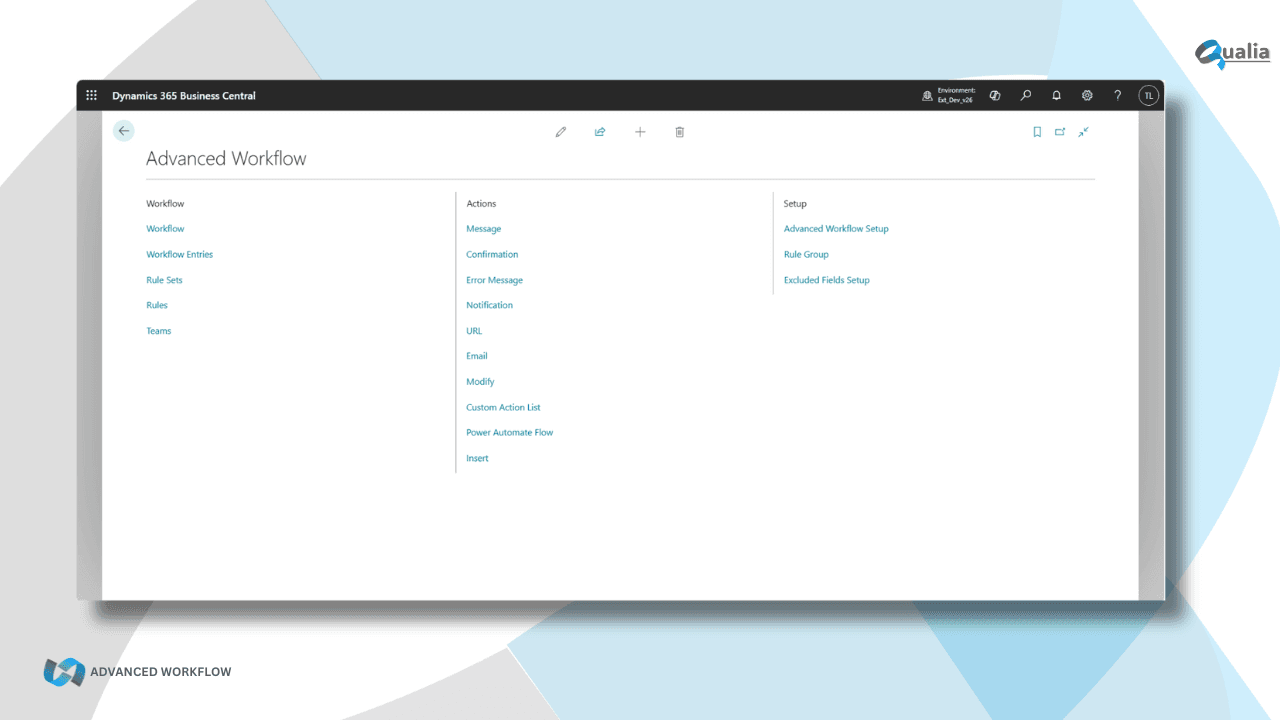
Built-In Business Rules Engine: Advanced Work Flow includes complete Business Rules engine for task validation. 10 action types available: Error/Message/Confirmation/Notification/Email/Assign/URL/Custom Action/Power Automate/Insert Record. Configure sophisticated task completion rules without coding.
Works with All BC Deployments: Compatible with Business Central Online (SaaS), on-premises installations, and hybrid environments. Supports BC version 22.0+. Regular updates maintain compatibility with latest BC releases.
Microsoft Ecosystem Integration: Seamlessly integrates with Power Platform (Power Automate flows, Teams notifications), Office 365 services, and Dynamics 365 ecosystem for extended automation scenarios.
Learn more about Business Central development in Microsoft's official documentation.
Getting Started: From Installation to First Workflow
Step 1: Install from AppSource
Find "0-Code Advanced Work Flow" in Microsoft AppSource. Click "Get it now" and complete installation wizard. Standard BC extension—installs in 5-10 minutes.
Step 2: Create Workflow Template
Navigate to Workflow Templates in Business Central. Create new template for "Purchase Requisition Approval." Specify trigger table (Purchase Requisition), trigger event (OnModify, when Status changes to "Pending Approval"), and workflow activation conditions (Amount > $1,000).
Step 3: Add Task Sequence
Add tasks in execution order:
Department Manager Review (assigned to manager role, due in 1 day)
Budget Verification (assigned to finance team, due in 1 day)
Director Approval (assigned to department director, due in 1 day)
PO Generation (assigned to purchasing agent, due in 1 day)
Define dependencies: Budget Verification starts after Manager Review completes. Director Approval requires BOTH Manager Review and Budget Verification complete.
Step 4: Configure Validation & Notifications
Add validation rules using built-in Business Rules:
Director Approval task requires "Justification" field populated (Error if blank)
PO Generation requires "Vendor No." selected (Error if empty)
Configure notifications:
Email assigned user when task becomes available
Send reminder 1 day before due date
Escalate to manager if task overdue by 2 days
Step 5: Test and Activate
Use test mode to validate workflow logic. Create test requisition that triggers workflow. Verify tasks created in correct sequence. Complete tasks and confirm dependencies enforced, validations work, notifications sent. When satisfied, activate the template. Your first workflow is live!
From this point forward, requisitions are approved automatically. Workflow instances created when trigger conditions met. Tasks assigned to appropriate people. Progress tracked visually. Escalations handled automatically. Complete audit trail maintained.
Most organizations configure 5-15 workflow templates in the first month: employee onboarding, vendor setup, purchase approvals, credit reviews, inventory replenishment, service requests, contract approvals, month-end tasks. Once configured, workflows orchestrate processes forever—no manual coordination needed.
Why Choose 0-Code Advanced Work Flow
Simpler Than Enterprise Workflow Systems
Business analysts configure workflows—no IT specialists or consultants needed.
Enterprise workflow platforms require extensive configuration, complex rule engines, and specialized training. Advanced Work Flow uses Business Central's familiar interface with tables, fields, and filters you already know. If you can configure BC pages and create record filters, you can build workflows.
No external systems. Everything runs within Business Central. No middleware. No integration complexity. No separate login for workflow management. Your team already knows the interface.
Visual Process Tracking & Management
See every workflow's status in real-time. No more "where is this in the process?" questions.
Workflow Instance page shows all active workflows with current task, assigned user, days elapsed, tasks completed, tasks remaining. Drill into any workflow to see complete task timeline—what's done, what's pending, what's overdue. Identify bottlenecks immediately.
Team workload visibility: See how many tasks each person has assigned. Balance workload across team. Identify when someone needs help. Prevent task overload before it impacts delivery.
Process improvement insights: Analyze completed workflows to see average completion time, common bottlenecks, which tasks take longest. Use data to optimize processes continuously.
Comprehensive Task Orchestration
Beyond simple approvals. Handle complex multi-step processes with parallel tasks, dependencies, conditional logic, and cross-department coordination.
Sequential tasks (Step 2 after Step 1). Parallel tasks (Steps 2 and 3 simultaneously after Step 1). Conditional tasks (add extra approval if amount > $10,000). Dependent tasks (Step 4 requires Steps 2 AND 3 complete). All configurable visually.
19+ workflow scenario types supported: Onboarding, vendor setup, approvals, alerts, operational processes, compliance workflows, cross-department coordination, service requests, document reviews, quality processes, replenishment, month-end tasks, customer onboarding, contract management, and more.
Built-In Validation Engine
Advanced Work Flow includes complete Business Rules engine for sophisticated task validation.
Configure validation rules that enforce data quality before task completion. Require mandatory fields populated. Validate cross-table relationships. Execute automatic actions (emails, notifications, field updates) when tasks complete. All without coding.
10 action types available for task automation: Error (block task completion), Message (display information), Confirmation (require yes/no), Notification (BC notification), Email (send emails with attachments), Assign (auto-populate fields), URL (open web pages), Custom Action (call AL code), Power Automate (trigger cloud flows), Insert Record (create audit logs).
One platform for both workflow orchestration AND business rule automation—eliminating need for separate validation tools.
Automatic Escalation & Accountability
Nothing falls through the cracks. Automatic reminders and escalations ensure timely task completion.
Configure escalation rules: Reminder 1 day before due date. Daily notifications if overdue. Manager escalation if 2+ days late. Each workflow template can have custom escalation policies.
Complete accountability: Every task logged with assigned user, due date, completion date, actual user who completed it, notes documenting decisions. Audit trail proves who did what when for compliance and quality reviews.
Dedicated BC Expertise
The 0-Code support team knows Business Central table structures, business processes, and workflow patterns deeply. We speak your language—posting routines, approval hierarchies, document flows, compliance requirements.
Regular updates maintain compatibility with latest BC versions. We monitor Microsoft BC roadmap and test thoroughly before each release. Your workflows keep working as BC evolves.
Value That Scales
Start with one workflow, expand to dozens. Pricing scales with usage. ROI typically realized within first month through eliminated manual coordination, faster process completion, and prevented errors.
Time savings: Processes that took weeks complete in days. Manual coordination eliminated. Follow-up emails automated. Status visibility instant instead of requiring meetings.
Stop Manual Process Coordination, Start Workflow Automation
Stop email chains, spreadsheet trackers, and manual follow-ups. Orchestrate multi-step business processes automatically through Business Central workflow automation—task sequencing, team coordination, progress tracking, and accountability without coding.
Join hundreds of BC users who've eliminated process bottlenecks and improved operational efficiency through intelligent workflow orchestration.
Start Free Trial
30 days. Full features. No credit card. $15/user/month after trial.
Schedule a Live Demo
See Business Central workflow automation in action. 30-minute personalized demo showing your specific process orchestration scenarios.
Questions?
Talk to our Business Central automation specialists. We'll help you identify workflow opportunities and estimate efficiency improvements.
0-Code Business Central Advanced Work Flow | Automate multi-step processes without coding | Task orchestration, team coordination, progress tracking | Approvals, onboarding, operational workflows, compliance | No development required | Start free trial today
Business Rules • Advanced Work Flow • Email Automation • Power Automate Connector
Documentation • Support • Privacy • Terms
© 2026 Qualia Technik. Microsoft, Dynamics 365, Business Central are trademarks of Microsoft Corporation.
Advanced Workflow: Multi-Step Process Orchestration for Business Central
Automate multi-step business processes in Microsoft Dynamics 365 Business Central—without writing code. Orchestrate task sequences, coordinate teams, track progress visually, and ensure nothing falls through the cracks. From employee onboarding to purchase approvals, inventory alerts to compliance workflows—Business Central workflow automation handles your most complex processes with simple configuration.
Business Central Advanced Work Flow | No-Code Multi-Step Process Automation
Automate multi-step business processes in Microsoft Dynamics 365 Business Central—without writing code. Orchestrate task sequences, coordinate teams, track progress visually, and ensure nothing falls through the cracks.
All-in-one solution: Includes the complete Business Rules engine (all 10 action types) built-in—no need to buy Business Rules separately—PLUS workflow orchestration, task management, and visual tracking.
Pricing: $15/user/month – Only users who work with workflows need licenses
✓ Verified Microsoft AppSource Publisher | ✓ Compatible with BC v14-v25 | ✓ 30-Day Money-Back Guarantee
Key Benefits
✓ Automate any multi-step process—onboarding, approvals, compliance, operations
✓ Visual workflow builder—define tasks, dependencies, escalations
✓ Built-in Business Rules engine—10 action types for validation and automation
✓ Real-time progress tracking and audit trail
✓ No coding required—business analysts can configure
✓ Works with all BC tables (standard, ISV, custom)
The Multi-Step Process Challenge
Business Central handles transactions brilliantly. But what about the processes around those transactions?
Employee onboarding requires 12 steps across HR, IT, and Finance—coordinated over 2 weeks. New vendor setup needs purchasing review, finance approval, IT configuration, and manager sign-off. Customer credit limit increases demand sales manager assessment, finance director approval, and AR team notification. Inventory replenishment triggers purchasing tasks, receiving verification, quality checks, and bin placement coordination.
These aren't single actions—they're orchestrated processes requiring:
Task sequencing: Step 2 can't start until Step 1 completes
Team coordination: Different people handle different steps
Progress visibility: Managers need to see where each process stands
Deadline tracking: Time-sensitive tasks need escalation if delayed
Audit trails: Compliance requires documentation of who did what when
Without automation, organizations rely on email chains, spreadsheets, manual follow-ups, and institutional knowledge. Tasks get forgotten. Processes stall. Nobody knows current status. Bottlenecks go undetected.
You need workflow automation—but enterprise workflow systems are complex, expensive, and require extensive IT configuration. You want BC-native task orchestration that business analysts can configure.
The Solution: Visual Multi-Step Process Automation
0-Code Advanced Work Flow brings comprehensive workflow automation to Business Central—orchestrating tasks, coordinating teams, tracking progress, and ensuring accountability across your most complex business processes.
Configure workflows visually through Business Central pages. Define task sequences, assign responsibilities, set dependencies, establish escalation rules. Watch processes execute automatically with real-time visibility into every task's status.
What You Can Automate
Onboarding & Setup Workflows
Employee onboarding: HR documentation → IT account setup → Equipment assignment → Training scheduling → Manager introduction → Payroll enrollment
Vendor setup: Purchasing review → Tax form collection → Payment terms negotiation → Finance approval → System configuration → First order placement
Customer onboarding: Credit application → Reference checks → Terms approval → Account setup → Sales territory assignment → Welcome communication
Operational Process Workflows
Inventory replenishment: Stock level alert → Purchasing review → Vendor selection → PO creation → Receiving verification → Quality check → Bin placement
Shipment preparation: Order allocation → Picking task → Quality inspection → Packing → Carrier booking → Documentation → Loading coordination
Service request handling: Request logging → Technician assignment → Parts ordering → Scheduling → Service execution → Quality verification → Customer follow-up
Approval Process Workflows
Purchase requisitions: Department manager review → Budget verification → Purchasing evaluation → Director approval → Vendor selection → PO generation
Credit limit increases: Sales manager recommendation → Credit report review → Finance analysis → Director approval → AR notification → Customer communication
Discount approvals: Sales rep request → Regional manager review → Pricing analysis → VP approval → Quote update → Customer notification
Capital expenditure: Department justification → Finance review → VP recommendation → Executive approval → Budget allocation → Procurement initiation
Notification & Alert Workflows
Customer credit monitoring: Credit threshold exceeded → Account manager alert → Finance notification → Hold order task → Customer contact → Resolution tracking
Quality issue escalation: Defect detection → Supervisor notification → Investigation task → Supplier contact → Corrective action → Management reporting
Aging inventory alerts: Stock age threshold → Purchasing notification → Review task → Disposition decision → Action execution → Accounting adjustment
Complex Multi-Step Workflows
Quote-to-order conversion: Quote approval → Legal review → Finance terms → Customer acceptance → Configuration verification → Production scheduling → Order creation
Return processing: Return authorization → Receiving task → Inspection → Disposition decision → Credit processing → Customer notification → Vendor claim (if applicable)
Month-end closing: Journal preparation → Department review → Reconciliation tasks → Adjustments → Manager approval → Final close → Reporting
Document & Compliance Workflows
Contract approval: Legal review → Compliance check → Finance approval → Executive signature → Document archival → Renewal scheduling
Audit response: Request reception → Document collection → Review tasks → Response preparation → Management approval → Submission → Follow-up tracking
Cross-Department Coordination
New product launch: R&D handoff → Manufacturing setup → Inventory planning → Pricing approval → Sales training → Marketing launch → Order activation
Location opening: Facilities setup → IT infrastructure → Inventory transfer → Staff hiring → System configuration → Licensing → Grand opening
All configured without coding—using Business Central's familiar interface and your existing BC data.
How Business Central Workflow Automation Works
1. Define Workflow Template
Create workflow template defining your process structure. Specify workflow name ("New Vendor Onboarding"), description, and which BC table triggers the workflow (Vendor table, OnInsert event). One template = one process type.
2. Configure Task Sequence
Add tasks in execution order:
Purchasing Review (assigned to Purchasing team)
Tax Form Collection (assigned to Compliance specialist)
Payment Terms Negotiation (assigned to Buyer)
Finance Approval (assigned to Finance Manager)
System Configuration (assigned to IT Administrator)
First Order Coordination (assigned to Purchasing Agent)
Each task has: Name, Description, Assigned User/Team, Due Date Formula (+2D, +1W, etc.), Priority level.
3. Set Task Dependencies
Define which tasks must complete before others start:
Tax Form Collection starts after Purchasing Review completes
Payment Terms Negotiation starts after Purchasing Review completes (parallel to Tax Form)
Finance Approval starts after BOTH Tax Form Collection AND Payment Terms complete
System Configuration starts after Finance Approval
First Order Coordination starts after System Configuration
Dependencies ensure proper sequencing—no task executes prematurely.
4. Configure Validation Rules
Leverage built-in Business Rules engine for task validation:
Finance Approval task requires "Payment Terms Code" populated before completion
System Configuration requires "Vendor Posting Group" assigned
Each task can have mandatory field checks, data validation, cross-table verification
Validation prevents incomplete task completion—ensuring data quality throughout the process.
5. Establish Escalation & Notifications
Set automatic escalation for overdue tasks:
Send reminder notification 1 day before due date
Escalate to manager if task remains incomplete 2 days after due date
Email task owner daily until completion
Configure task notifications:
Email assigned user when task becomes available
Notify team when high-priority task created
Alert manager when workflow completes or encounters issues
6. Activate & Monitor
Activate workflow template. From that point forward, workflows execute automatically when trigger conditions met (new vendor inserted, credit limit modified, inventory below reorder point).
Monitor workflows visually through Workflow Instance page:
See all active workflows with current status
Drill into individual workflow to see task completion timeline
Identify bottlenecks (which tasks delay most workflows)
Track team workload (how many tasks each person has)
Review completed workflows for process improvement insights
Real-World Workflow Scenarios
Scenario 1: Employee Onboarding Workflow
Trigger: HR creates new employee record in Business Central
Automated Task Sequence:
HR Documentation (HR Specialist, Day 1): Complete employment paperwork, benefits enrollment forms, emergency contacts
IT Account Setup (IT Administrator, Day 1-2): Create network account, email, system access permissions
Equipment Assignment (IT Support, Day 2-3): Assign laptop, phone, access badge based on department
Training Scheduling (Training Coordinator, Day 3-5): Schedule role-specific training sessions, system onboarding
Manager Introduction (Department Manager, Day 5): First-day welcome meeting, team introductions, expectations discussion
Payroll Enrollment (Payroll Specialist, Day 5-7): Direct deposit setup, tax withholding, benefits deductions
Dependencies: Equipment assignment can't start until IT accounts exist. Manager introduction scheduled after training dates confirmed. Payroll enrollment requires all documentation complete.
Validations: IT task requires "Email Address" populated. Equipment task requires "Department Code" assigned. Payroll task requires "Bank Account No." entered.
Escalations: Any task overdue by 1 day escalates to department director. Critical tasks (IT, Payroll) get daily reminders.
Result: 12-step, 2-week onboarding process orchestrated automatically. New employee productive from day one. Zero tasks forgotten. Complete audit trail of who did what when.
Scenario 2: Purchase Requisition Approval Workflow
Trigger: Employee creates purchase requisition exceeding $1,000
Automated Task Sequence:
Department Manager Review (Manager, 1 day): Verify business justification, budget availability
Budget Verification (Finance Analyst, 1 day): Confirm budget line item has available funds
Purchasing Evaluation (Buyer, 2 days): Source vendors, negotiate pricing, evaluate options
Director Approval (Department Director, 1 day): Final authorization for expenditure
PO Generation (Purchasing Agent, 1 day): Create purchase order, send to approved vendor
Conditional Logic: If requisition > $10,000, add "VP Approval" task after Director Approval. If requisition for IT equipment, add "IT Standards Review" task before Purchasing Evaluation.
Validations: Purchasing Evaluation requires "Vendor No." selected and "Unit Cost" entered. Director Approval can only complete if Budget Verification passed.
Notifications: Email manager when requisition submitted. Alert director when their approval task available. Notify requester when PO generated or if rejected.
Result: Complex approval chain automated. Appropriate authority levels enforced. Budget compliance guaranteed. 5-day average requisition-to-PO time vs. 15 days manual process.
Scenario 3: Customer Credit Limit Increase Workflow
Trigger: Sales rep modifies customer credit limit to value exceeding current limit by >$5,000
Automated Task Sequence:
Sales Manager Assessment (Sales Manager, 1 day): Review sales history, payment behavior, relationship strength
Credit Report Review (Credit Analyst, 1 day): Pull credit report, analyze financial statements, assess risk
Finance Analysis (Finance Manager, 2 days): Review AR aging, payment patterns, calculate risk exposure
Director Approval (Finance Director, 1 day): Final authorization based on sales/credit/finance input
AR Notification (AR Specialist, same day): Update customer record, notify AR team of new limit
Customer Communication (Sales Rep, same day): Inform customer of approved limit increase
Dependencies: Credit Report and Sales Assessment run in parallel. Finance Analysis waits for BOTH to complete. Approval requires Finance Analysis. Notifications occur only after Approval completes.
Validations: Finance Analysis task requires "Risk Score" calculation populated. Director Approval requires all prior tasks marked complete and "Approval Notes" documented.
Escalations: Director Approval escalates to CFO if not completed within 24 hours (time-sensitive credit decisions).
Audit Trail: Complete log of who recommended what, what criteria were evaluated, when approval granted—critical for credit policy compliance.
Result: Credit decisions made consistently using standardized criteria. Appropriate authority levels enforced. Fast turnaround (5 days vs. 10+ days manual). Complete audit trail for regulators.
Scenario 4: Inventory Replenishment Workflow
Trigger: Item inventory quantity drops below reorder point
Automated Task Sequence:
Purchasing Review (Buyer, 1 day): Verify reorder quantity, check demand forecast, evaluate lead time
Vendor Selection (Buyer, same day): Choose vendor based on pricing, delivery time, quality history
PO Creation (Purchasing Agent, same day): Generate purchase order for reorder quantity
Receiving Notification (Warehouse Supervisor, when goods arrive): Schedule receiving, assign dock
Quality Check (QC Inspector, upon receipt): Inspect goods for quality, quantity, damage
Bin Placement (Warehouse Worker, after QC pass): Put away inventory to designated bins, update bin content
Validations: PO Creation requires "Vendor No." and "Expected Receipt Date" populated. Quality Check requires "Inspection Result" = Pass before Bin Placement can start.
Notifications: Email buyer when inventory hits reorder point. Alert warehouse supervisor 1 day before expected receipt. Notify purchasing if QC inspection fails.
Conditional Logic: If item is hazardous material, add "Safety Review" task before Bin Placement. If order value > $50,000, add "Manager Approval" before PO Creation.
Result: Stockouts prevented through automated replenishment triggers. Receiving coordinated efficiently. Quality assured before inventory available. Complete traceability from reorder trigger to bin placement.
Works Everywhere: Universal BC Compatibility
Not just standard tables. Create workflows for any Business Central table or extension.
Compatible with all standard Business Central tables, ISV extension tables, and custom tables or fields you've created. Whether you're using Microsoft's standard functionality, third-party apps, or custom modifications—Advanced Work Flow orchestrates processes seamlessly across your entire BC environment.
Automate processes for:
Human Resources: Employee onboarding, performance reviews, time-off approvals, training coordination
Sales & CRM: Quote approvals, contract reviews, customer onboarding, credit limit changes
Purchasing: Requisition approvals, vendor setup, PO reviews, receiving coordination
Inventory: Replenishment workflows, transfer approvals, cycle count coordination, quality inspections
Finance: Month-end closing tasks, journal approvals, bank reconciliation reviews, audit responses
Service: Service order assignment, technician coordination, parts ordering, customer follow-up
Manufacturing: Production order approvals, material release, quality checks, maintenance scheduling
Projects: Milestone approvals, resource assignment, budget reviews, deliverable coordination
Any BC table (standard, ISV, custom), any business process, any workflow scenario—fully compatible.
Seamless Business Central Integration
Advanced Work Flow integrates natively with Business Central—no external workflow engines, no middleware, no separate systems.
Native BC Extension: Installs from AppSource like any BC app. Uses standard extension framework. Follows Microsoft best practices. Updates automatically with BC releases.
Leverages BC Data: Tasks reference BC tables, fields, records directly. No data duplication. No synchronization issues. Real-time access to current BC data for validation and decision-making.
Honors BC Security: Workflows execute within user's security context. Task assignments respect BC user permissions. Role-based access enforced. Field-level security maintained.
Built-In Business Rules Engine: Advanced Work Flow includes complete Business Rules engine for task validation. 10 action types available: Error/Message/Confirmation/Notification/Email/Assign/URL/Custom Action/Power Automate/Insert Record. Configure sophisticated task completion rules without coding.
Works with All BC Deployments: Compatible with Business Central Online (SaaS), on-premises installations, and hybrid environments. Supports BC version 22.0+. Regular updates maintain compatibility with latest BC releases.
Microsoft Ecosystem Integration: Seamlessly integrates with Power Platform (Power Automate flows, Teams notifications), Office 365 services, and Dynamics 365 ecosystem for extended automation scenarios.
Learn more about Business Central development in Microsoft's official documentation.
Getting Started: From Installation to First Workflow
Step 1: Install from AppSource
Find "0-Code Advanced Work Flow" in Microsoft AppSource. Click "Get it now" and complete installation wizard. Standard BC extension—installs in 5-10 minutes.
Step 2: Create Workflow Template
Navigate to Workflow Templates in Business Central. Create new template for "Purchase Requisition Approval." Specify trigger table (Purchase Requisition), trigger event (OnModify, when Status changes to "Pending Approval"), and workflow activation conditions (Amount > $1,000).
Step 3: Add Task Sequence
Add tasks in execution order:
Department Manager Review (assigned to manager role, due in 1 day)
Budget Verification (assigned to finance team, due in 1 day)
Director Approval (assigned to department director, due in 1 day)
PO Generation (assigned to purchasing agent, due in 1 day)
Define dependencies: Budget Verification starts after Manager Review completes. Director Approval requires BOTH Manager Review and Budget Verification complete.
Step 4: Configure Validation & Notifications
Add validation rules using built-in Business Rules:
Director Approval task requires "Justification" field populated (Error if blank)
PO Generation requires "Vendor No." selected (Error if empty)
Configure notifications:
Email assigned user when task becomes available
Send reminder 1 day before due date
Escalate to manager if task overdue by 2 days
Step 5: Test and Activate
Use test mode to validate workflow logic. Create test requisition that triggers workflow. Verify tasks created in correct sequence. Complete tasks and confirm dependencies enforced, validations work, notifications sent. When satisfied, activate the template. Your first workflow is live!
From this point forward, requisitions are approved automatically. Workflow instances created when trigger conditions met. Tasks assigned to appropriate people. Progress tracked visually. Escalations handled automatically. Complete audit trail maintained.
Most organizations configure 5-15 workflow templates in the first month: employee onboarding, vendor setup, purchase approvals, credit reviews, inventory replenishment, service requests, contract approvals, month-end tasks. Once configured, workflows orchestrate processes forever—no manual coordination needed.
Why Choose 0-Code Advanced Work Flow
Simpler Than Enterprise Workflow Systems
Business analysts configure workflows—no IT specialists or consultants needed.
Enterprise workflow platforms require extensive configuration, complex rule engines, and specialized training. Advanced Work Flow uses Business Central's familiar interface with tables, fields, and filters you already know. If you can configure BC pages and create record filters, you can build workflows.
No external systems. Everything runs within Business Central. No middleware. No integration complexity. No separate login for workflow management. Your team already knows the interface.
Visual Process Tracking & Management
See every workflow's status in real-time. No more "where is this in the process?" questions.
Workflow Instance page shows all active workflows with current task, assigned user, days elapsed, tasks completed, tasks remaining. Drill into any workflow to see complete task timeline—what's done, what's pending, what's overdue. Identify bottlenecks immediately.
Team workload visibility: See how many tasks each person has assigned. Balance workload across team. Identify when someone needs help. Prevent task overload before it impacts delivery.
Process improvement insights: Analyze completed workflows to see average completion time, common bottlenecks, which tasks take longest. Use data to optimize processes continuously.
Comprehensive Task Orchestration
Beyond simple approvals. Handle complex multi-step processes with parallel tasks, dependencies, conditional logic, and cross-department coordination.
Sequential tasks (Step 2 after Step 1). Parallel tasks (Steps 2 and 3 simultaneously after Step 1). Conditional tasks (add extra approval if amount > $10,000). Dependent tasks (Step 4 requires Steps 2 AND 3 complete). All configurable visually.
19+ workflow scenario types supported: Onboarding, vendor setup, approvals, alerts, operational processes, compliance workflows, cross-department coordination, service requests, document reviews, quality processes, replenishment, month-end tasks, customer onboarding, contract management, and more.
Built-In Validation Engine
Advanced Work Flow includes complete Business Rules engine for sophisticated task validation.
Configure validation rules that enforce data quality before task completion. Require mandatory fields populated. Validate cross-table relationships. Execute automatic actions (emails, notifications, field updates) when tasks complete. All without coding.
10 action types available for task automation: Error (block task completion), Message (display information), Confirmation (require yes/no), Notification (BC notification), Email (send emails with attachments), Assign (auto-populate fields), URL (open web pages), Custom Action (call AL code), Power Automate (trigger cloud flows), Insert Record (create audit logs).
One platform for both workflow orchestration AND business rule automation—eliminating need for separate validation tools.
Automatic Escalation & Accountability
Nothing falls through the cracks. Automatic reminders and escalations ensure timely task completion.
Configure escalation rules: Reminder 1 day before due date. Daily notifications if overdue. Manager escalation if 2+ days late. Each workflow template can have custom escalation policies.
Complete accountability: Every task logged with assigned user, due date, completion date, actual user who completed it, notes documenting decisions. Audit trail proves who did what when for compliance and quality reviews.
Dedicated BC Expertise
The 0-Code support team knows Business Central table structures, business processes, and workflow patterns deeply. We speak your language—posting routines, approval hierarchies, document flows, compliance requirements.
Regular updates maintain compatibility with latest BC versions. We monitor Microsoft BC roadmap and test thoroughly before each release. Your workflows keep working as BC evolves.
Value That Scales
Start with one workflow, expand to dozens. Pricing scales with usage. ROI typically realized within first month through eliminated manual coordination, faster process completion, and prevented errors.
Time savings: Processes that took weeks complete in days. Manual coordination eliminated. Follow-up emails automated. Status visibility instant instead of requiring meetings.
Stop Manual Process Coordination, Start Workflow Automation
Stop email chains, spreadsheet trackers, and manual follow-ups. Orchestrate multi-step business processes automatically through Business Central workflow automation—task sequencing, team coordination, progress tracking, and accountability without coding.
Join hundreds of BC users who've eliminated process bottlenecks and improved operational efficiency through intelligent workflow orchestration.
Start Free Trial
30 days. Full features. No credit card. $15/user/month after trial.
Schedule a Live Demo
See Business Central workflow automation in action. 30-minute personalized demo showing your specific process orchestration scenarios.
Questions?
Talk to our Business Central automation specialists. We'll help you identify workflow opportunities and estimate efficiency improvements.
0-Code Business Central Advanced Work Flow | Automate multi-step processes without coding | Task orchestration, team coordination, progress tracking | Approvals, onboarding, operational workflows, compliance | No development required | Start free trial today
Business Rules • Advanced Work Flow • Email Automation • Power Automate Connector
Documentation • Support • Privacy • Terms
© 2026 Qualia Technik. Microsoft, Dynamics 365, Business Central are trademarks of Microsoft Corporation.
Advanced Workflow: Multi-Step Process Orchestration for Business Central
Automate multi-step business processes in Microsoft Dynamics 365 Business Central—without writing code. Orchestrate task sequences, coordinate teams, track progress visually, and ensure nothing falls through the cracks. From employee onboarding to purchase approvals, inventory alerts to compliance workflows—Business Central workflow automation handles your most complex processes with simple configuration.
Business Central Advanced Work Flow | No-Code Multi-Step Process Automation
Automate multi-step business processes in Microsoft Dynamics 365 Business Central—without writing code. Orchestrate task sequences, coordinate teams, track progress visually, and ensure nothing falls through the cracks.
All-in-one solution: Includes the complete Business Rules engine (all 10 action types) built-in—no need to buy Business Rules separately—PLUS workflow orchestration, task management, and visual tracking.
Pricing: $15/user/month – Only users who work with workflows need licenses
✓ Verified Microsoft AppSource Publisher | ✓ Compatible with BC v14-v25 | ✓ 30-Day Money-Back Guarantee
Key Benefits
✓ Automate any multi-step process—onboarding, approvals, compliance, operations
✓ Visual workflow builder—define tasks, dependencies, escalations
✓ Built-in Business Rules engine—10 action types for validation and automation
✓ Real-time progress tracking and audit trail
✓ No coding required—business analysts can configure
✓ Works with all BC tables (standard, ISV, custom)
The Multi-Step Process Challenge
Business Central handles transactions brilliantly. But what about the processes around those transactions?
Employee onboarding requires 12 steps across HR, IT, and Finance—coordinated over 2 weeks. New vendor setup needs purchasing review, finance approval, IT configuration, and manager sign-off. Customer credit limit increases demand sales manager assessment, finance director approval, and AR team notification. Inventory replenishment triggers purchasing tasks, receiving verification, quality checks, and bin placement coordination.
These aren't single actions—they're orchestrated processes requiring:
Task sequencing: Step 2 can't start until Step 1 completes
Team coordination: Different people handle different steps
Progress visibility: Managers need to see where each process stands
Deadline tracking: Time-sensitive tasks need escalation if delayed
Audit trails: Compliance requires documentation of who did what when
Without automation, organizations rely on email chains, spreadsheets, manual follow-ups, and institutional knowledge. Tasks get forgotten. Processes stall. Nobody knows current status. Bottlenecks go undetected.
You need workflow automation—but enterprise workflow systems are complex, expensive, and require extensive IT configuration. You want BC-native task orchestration that business analysts can configure.
The Solution: Visual Multi-Step Process Automation
0-Code Advanced Work Flow brings comprehensive workflow automation to Business Central—orchestrating tasks, coordinating teams, tracking progress, and ensuring accountability across your most complex business processes.
Configure workflows visually through Business Central pages. Define task sequences, assign responsibilities, set dependencies, establish escalation rules. Watch processes execute automatically with real-time visibility into every task's status.
What You Can Automate
Onboarding & Setup Workflows
Employee onboarding: HR documentation → IT account setup → Equipment assignment → Training scheduling → Manager introduction → Payroll enrollment
Vendor setup: Purchasing review → Tax form collection → Payment terms negotiation → Finance approval → System configuration → First order placement
Customer onboarding: Credit application → Reference checks → Terms approval → Account setup → Sales territory assignment → Welcome communication
Operational Process Workflows
Inventory replenishment: Stock level alert → Purchasing review → Vendor selection → PO creation → Receiving verification → Quality check → Bin placement
Shipment preparation: Order allocation → Picking task → Quality inspection → Packing → Carrier booking → Documentation → Loading coordination
Service request handling: Request logging → Technician assignment → Parts ordering → Scheduling → Service execution → Quality verification → Customer follow-up
Approval Process Workflows
Purchase requisitions: Department manager review → Budget verification → Purchasing evaluation → Director approval → Vendor selection → PO generation
Credit limit increases: Sales manager recommendation → Credit report review → Finance analysis → Director approval → AR notification → Customer communication
Discount approvals: Sales rep request → Regional manager review → Pricing analysis → VP approval → Quote update → Customer notification
Capital expenditure: Department justification → Finance review → VP recommendation → Executive approval → Budget allocation → Procurement initiation
Notification & Alert Workflows
Customer credit monitoring: Credit threshold exceeded → Account manager alert → Finance notification → Hold order task → Customer contact → Resolution tracking
Quality issue escalation: Defect detection → Supervisor notification → Investigation task → Supplier contact → Corrective action → Management reporting
Aging inventory alerts: Stock age threshold → Purchasing notification → Review task → Disposition decision → Action execution → Accounting adjustment
Complex Multi-Step Workflows
Quote-to-order conversion: Quote approval → Legal review → Finance terms → Customer acceptance → Configuration verification → Production scheduling → Order creation
Return processing: Return authorization → Receiving task → Inspection → Disposition decision → Credit processing → Customer notification → Vendor claim (if applicable)
Month-end closing: Journal preparation → Department review → Reconciliation tasks → Adjustments → Manager approval → Final close → Reporting
Document & Compliance Workflows
Contract approval: Legal review → Compliance check → Finance approval → Executive signature → Document archival → Renewal scheduling
Audit response: Request reception → Document collection → Review tasks → Response preparation → Management approval → Submission → Follow-up tracking
Cross-Department Coordination
New product launch: R&D handoff → Manufacturing setup → Inventory planning → Pricing approval → Sales training → Marketing launch → Order activation
Location opening: Facilities setup → IT infrastructure → Inventory transfer → Staff hiring → System configuration → Licensing → Grand opening
All configured without coding—using Business Central's familiar interface and your existing BC data.
How Business Central Workflow Automation Works
1. Define Workflow Template
Create workflow template defining your process structure. Specify workflow name ("New Vendor Onboarding"), description, and which BC table triggers the workflow (Vendor table, OnInsert event). One template = one process type.
2. Configure Task Sequence
Add tasks in execution order:
Purchasing Review (assigned to Purchasing team)
Tax Form Collection (assigned to Compliance specialist)
Payment Terms Negotiation (assigned to Buyer)
Finance Approval (assigned to Finance Manager)
System Configuration (assigned to IT Administrator)
First Order Coordination (assigned to Purchasing Agent)
Each task has: Name, Description, Assigned User/Team, Due Date Formula (+2D, +1W, etc.), Priority level.
3. Set Task Dependencies
Define which tasks must complete before others start:
Tax Form Collection starts after Purchasing Review completes
Payment Terms Negotiation starts after Purchasing Review completes (parallel to Tax Form)
Finance Approval starts after BOTH Tax Form Collection AND Payment Terms complete
System Configuration starts after Finance Approval
First Order Coordination starts after System Configuration
Dependencies ensure proper sequencing—no task executes prematurely.
4. Configure Validation Rules
Leverage built-in Business Rules engine for task validation:
Finance Approval task requires "Payment Terms Code" populated before completion
System Configuration requires "Vendor Posting Group" assigned
Each task can have mandatory field checks, data validation, cross-table verification
Validation prevents incomplete task completion—ensuring data quality throughout the process.
5. Establish Escalation & Notifications
Set automatic escalation for overdue tasks:
Send reminder notification 1 day before due date
Escalate to manager if task remains incomplete 2 days after due date
Email task owner daily until completion
Configure task notifications:
Email assigned user when task becomes available
Notify team when high-priority task created
Alert manager when workflow completes or encounters issues
6. Activate & Monitor
Activate workflow template. From that point forward, workflows execute automatically when trigger conditions met (new vendor inserted, credit limit modified, inventory below reorder point).
Monitor workflows visually through Workflow Instance page:
See all active workflows with current status
Drill into individual workflow to see task completion timeline
Identify bottlenecks (which tasks delay most workflows)
Track team workload (how many tasks each person has)
Review completed workflows for process improvement insights
Real-World Workflow Scenarios
Scenario 1: Employee Onboarding Workflow
Trigger: HR creates new employee record in Business Central
Automated Task Sequence:
HR Documentation (HR Specialist, Day 1): Complete employment paperwork, benefits enrollment forms, emergency contacts
IT Account Setup (IT Administrator, Day 1-2): Create network account, email, system access permissions
Equipment Assignment (IT Support, Day 2-3): Assign laptop, phone, access badge based on department
Training Scheduling (Training Coordinator, Day 3-5): Schedule role-specific training sessions, system onboarding
Manager Introduction (Department Manager, Day 5): First-day welcome meeting, team introductions, expectations discussion
Payroll Enrollment (Payroll Specialist, Day 5-7): Direct deposit setup, tax withholding, benefits deductions
Dependencies: Equipment assignment can't start until IT accounts exist. Manager introduction scheduled after training dates confirmed. Payroll enrollment requires all documentation complete.
Validations: IT task requires "Email Address" populated. Equipment task requires "Department Code" assigned. Payroll task requires "Bank Account No." entered.
Escalations: Any task overdue by 1 day escalates to department director. Critical tasks (IT, Payroll) get daily reminders.
Result: 12-step, 2-week onboarding process orchestrated automatically. New employee productive from day one. Zero tasks forgotten. Complete audit trail of who did what when.
Scenario 2: Purchase Requisition Approval Workflow
Trigger: Employee creates purchase requisition exceeding $1,000
Automated Task Sequence:
Department Manager Review (Manager, 1 day): Verify business justification, budget availability
Budget Verification (Finance Analyst, 1 day): Confirm budget line item has available funds
Purchasing Evaluation (Buyer, 2 days): Source vendors, negotiate pricing, evaluate options
Director Approval (Department Director, 1 day): Final authorization for expenditure
PO Generation (Purchasing Agent, 1 day): Create purchase order, send to approved vendor
Conditional Logic: If requisition > $10,000, add "VP Approval" task after Director Approval. If requisition for IT equipment, add "IT Standards Review" task before Purchasing Evaluation.
Validations: Purchasing Evaluation requires "Vendor No." selected and "Unit Cost" entered. Director Approval can only complete if Budget Verification passed.
Notifications: Email manager when requisition submitted. Alert director when their approval task available. Notify requester when PO generated or if rejected.
Result: Complex approval chain automated. Appropriate authority levels enforced. Budget compliance guaranteed. 5-day average requisition-to-PO time vs. 15 days manual process.
Scenario 3: Customer Credit Limit Increase Workflow
Trigger: Sales rep modifies customer credit limit to value exceeding current limit by >$5,000
Automated Task Sequence:
Sales Manager Assessment (Sales Manager, 1 day): Review sales history, payment behavior, relationship strength
Credit Report Review (Credit Analyst, 1 day): Pull credit report, analyze financial statements, assess risk
Finance Analysis (Finance Manager, 2 days): Review AR aging, payment patterns, calculate risk exposure
Director Approval (Finance Director, 1 day): Final authorization based on sales/credit/finance input
AR Notification (AR Specialist, same day): Update customer record, notify AR team of new limit
Customer Communication (Sales Rep, same day): Inform customer of approved limit increase
Dependencies: Credit Report and Sales Assessment run in parallel. Finance Analysis waits for BOTH to complete. Approval requires Finance Analysis. Notifications occur only after Approval completes.
Validations: Finance Analysis task requires "Risk Score" calculation populated. Director Approval requires all prior tasks marked complete and "Approval Notes" documented.
Escalations: Director Approval escalates to CFO if not completed within 24 hours (time-sensitive credit decisions).
Audit Trail: Complete log of who recommended what, what criteria were evaluated, when approval granted—critical for credit policy compliance.
Result: Credit decisions made consistently using standardized criteria. Appropriate authority levels enforced. Fast turnaround (5 days vs. 10+ days manual). Complete audit trail for regulators.
Scenario 4: Inventory Replenishment Workflow
Trigger: Item inventory quantity drops below reorder point
Automated Task Sequence:
Purchasing Review (Buyer, 1 day): Verify reorder quantity, check demand forecast, evaluate lead time
Vendor Selection (Buyer, same day): Choose vendor based on pricing, delivery time, quality history
PO Creation (Purchasing Agent, same day): Generate purchase order for reorder quantity
Receiving Notification (Warehouse Supervisor, when goods arrive): Schedule receiving, assign dock
Quality Check (QC Inspector, upon receipt): Inspect goods for quality, quantity, damage
Bin Placement (Warehouse Worker, after QC pass): Put away inventory to designated bins, update bin content
Validations: PO Creation requires "Vendor No." and "Expected Receipt Date" populated. Quality Check requires "Inspection Result" = Pass before Bin Placement can start.
Notifications: Email buyer when inventory hits reorder point. Alert warehouse supervisor 1 day before expected receipt. Notify purchasing if QC inspection fails.
Conditional Logic: If item is hazardous material, add "Safety Review" task before Bin Placement. If order value > $50,000, add "Manager Approval" before PO Creation.
Result: Stockouts prevented through automated replenishment triggers. Receiving coordinated efficiently. Quality assured before inventory available. Complete traceability from reorder trigger to bin placement.
Works Everywhere: Universal BC Compatibility
Not just standard tables. Create workflows for any Business Central table or extension.
Compatible with all standard Business Central tables, ISV extension tables, and custom tables or fields you've created. Whether you're using Microsoft's standard functionality, third-party apps, or custom modifications—Advanced Work Flow orchestrates processes seamlessly across your entire BC environment.
Automate processes for:
Human Resources: Employee onboarding, performance reviews, time-off approvals, training coordination
Sales & CRM: Quote approvals, contract reviews, customer onboarding, credit limit changes
Purchasing: Requisition approvals, vendor setup, PO reviews, receiving coordination
Inventory: Replenishment workflows, transfer approvals, cycle count coordination, quality inspections
Finance: Month-end closing tasks, journal approvals, bank reconciliation reviews, audit responses
Service: Service order assignment, technician coordination, parts ordering, customer follow-up
Manufacturing: Production order approvals, material release, quality checks, maintenance scheduling
Projects: Milestone approvals, resource assignment, budget reviews, deliverable coordination
Any BC table (standard, ISV, custom), any business process, any workflow scenario—fully compatible.
Seamless Business Central Integration
Advanced Work Flow integrates natively with Business Central—no external workflow engines, no middleware, no separate systems.
Native BC Extension: Installs from AppSource like any BC app. Uses standard extension framework. Follows Microsoft best practices. Updates automatically with BC releases.
Leverages BC Data: Tasks reference BC tables, fields, records directly. No data duplication. No synchronization issues. Real-time access to current BC data for validation and decision-making.
Honors BC Security: Workflows execute within user's security context. Task assignments respect BC user permissions. Role-based access enforced. Field-level security maintained.
Built-In Business Rules Engine: Advanced Work Flow includes complete Business Rules engine for task validation. 10 action types available: Error/Message/Confirmation/Notification/Email/Assign/URL/Custom Action/Power Automate/Insert Record. Configure sophisticated task completion rules without coding.
Works with All BC Deployments: Compatible with Business Central Online (SaaS), on-premises installations, and hybrid environments. Supports BC version 22.0+. Regular updates maintain compatibility with latest BC releases.
Microsoft Ecosystem Integration: Seamlessly integrates with Power Platform (Power Automate flows, Teams notifications), Office 365 services, and Dynamics 365 ecosystem for extended automation scenarios.
Learn more about Business Central development in Microsoft's official documentation.
Getting Started: From Installation to First Workflow
Step 1: Install from AppSource
Find "0-Code Advanced Work Flow" in Microsoft AppSource. Click "Get it now" and complete installation wizard. Standard BC extension—installs in 5-10 minutes.
Step 2: Create Workflow Template
Navigate to Workflow Templates in Business Central. Create new template for "Purchase Requisition Approval." Specify trigger table (Purchase Requisition), trigger event (OnModify, when Status changes to "Pending Approval"), and workflow activation conditions (Amount > $1,000).
Step 3: Add Task Sequence
Add tasks in execution order:
Department Manager Review (assigned to manager role, due in 1 day)
Budget Verification (assigned to finance team, due in 1 day)
Director Approval (assigned to department director, due in 1 day)
PO Generation (assigned to purchasing agent, due in 1 day)
Define dependencies: Budget Verification starts after Manager Review completes. Director Approval requires BOTH Manager Review and Budget Verification complete.
Step 4: Configure Validation & Notifications
Add validation rules using built-in Business Rules:
Director Approval task requires "Justification" field populated (Error if blank)
PO Generation requires "Vendor No." selected (Error if empty)
Configure notifications:
Email assigned user when task becomes available
Send reminder 1 day before due date
Escalate to manager if task overdue by 2 days
Step 5: Test and Activate
Use test mode to validate workflow logic. Create test requisition that triggers workflow. Verify tasks created in correct sequence. Complete tasks and confirm dependencies enforced, validations work, notifications sent. When satisfied, activate the template. Your first workflow is live!
From this point forward, requisitions are approved automatically. Workflow instances created when trigger conditions met. Tasks assigned to appropriate people. Progress tracked visually. Escalations handled automatically. Complete audit trail maintained.
Most organizations configure 5-15 workflow templates in the first month: employee onboarding, vendor setup, purchase approvals, credit reviews, inventory replenishment, service requests, contract approvals, month-end tasks. Once configured, workflows orchestrate processes forever—no manual coordination needed.
Why Choose 0-Code Advanced Work Flow
Simpler Than Enterprise Workflow Systems
Business analysts configure workflows—no IT specialists or consultants needed.
Enterprise workflow platforms require extensive configuration, complex rule engines, and specialized training. Advanced Work Flow uses Business Central's familiar interface with tables, fields, and filters you already know. If you can configure BC pages and create record filters, you can build workflows.
No external systems. Everything runs within Business Central. No middleware. No integration complexity. No separate login for workflow management. Your team already knows the interface.
Visual Process Tracking & Management
See every workflow's status in real-time. No more "where is this in the process?" questions.
Workflow Instance page shows all active workflows with current task, assigned user, days elapsed, tasks completed, tasks remaining. Drill into any workflow to see complete task timeline—what's done, what's pending, what's overdue. Identify bottlenecks immediately.
Team workload visibility: See how many tasks each person has assigned. Balance workload across team. Identify when someone needs help. Prevent task overload before it impacts delivery.
Process improvement insights: Analyze completed workflows to see average completion time, common bottlenecks, which tasks take longest. Use data to optimize processes continuously.
Comprehensive Task Orchestration
Beyond simple approvals. Handle complex multi-step processes with parallel tasks, dependencies, conditional logic, and cross-department coordination.
Sequential tasks (Step 2 after Step 1). Parallel tasks (Steps 2 and 3 simultaneously after Step 1). Conditional tasks (add extra approval if amount > $10,000). Dependent tasks (Step 4 requires Steps 2 AND 3 complete). All configurable visually.
19+ workflow scenario types supported: Onboarding, vendor setup, approvals, alerts, operational processes, compliance workflows, cross-department coordination, service requests, document reviews, quality processes, replenishment, month-end tasks, customer onboarding, contract management, and more.
Built-In Validation Engine
Advanced Work Flow includes complete Business Rules engine for sophisticated task validation.
Configure validation rules that enforce data quality before task completion. Require mandatory fields populated. Validate cross-table relationships. Execute automatic actions (emails, notifications, field updates) when tasks complete. All without coding.
10 action types available for task automation: Error (block task completion), Message (display information), Confirmation (require yes/no), Notification (BC notification), Email (send emails with attachments), Assign (auto-populate fields), URL (open web pages), Custom Action (call AL code), Power Automate (trigger cloud flows), Insert Record (create audit logs).
One platform for both workflow orchestration AND business rule automation—eliminating need for separate validation tools.
Automatic Escalation & Accountability
Nothing falls through the cracks. Automatic reminders and escalations ensure timely task completion.
Configure escalation rules: Reminder 1 day before due date. Daily notifications if overdue. Manager escalation if 2+ days late. Each workflow template can have custom escalation policies.
Complete accountability: Every task logged with assigned user, due date, completion date, actual user who completed it, notes documenting decisions. Audit trail proves who did what when for compliance and quality reviews.
Dedicated BC Expertise
The 0-Code support team knows Business Central table structures, business processes, and workflow patterns deeply. We speak your language—posting routines, approval hierarchies, document flows, compliance requirements.
Regular updates maintain compatibility with latest BC versions. We monitor Microsoft BC roadmap and test thoroughly before each release. Your workflows keep working as BC evolves.
Value That Scales
Start with one workflow, expand to dozens. Pricing scales with usage. ROI typically realized within first month through eliminated manual coordination, faster process completion, and prevented errors.
Time savings: Processes that took weeks complete in days. Manual coordination eliminated. Follow-up emails automated. Status visibility instant instead of requiring meetings.
Stop Manual Process Coordination, Start Workflow Automation
Stop email chains, spreadsheet trackers, and manual follow-ups. Orchestrate multi-step business processes automatically through Business Central workflow automation—task sequencing, team coordination, progress tracking, and accountability without coding.
Join hundreds of BC users who've eliminated process bottlenecks and improved operational efficiency through intelligent workflow orchestration.
Start Free Trial
30 days. Full features. No credit card. $15/user/month after trial.
Schedule a Live Demo
See Business Central workflow automation in action. 30-minute personalized demo showing your specific process orchestration scenarios.
Questions?
Talk to our Business Central automation specialists. We'll help you identify workflow opportunities and estimate efficiency improvements.
0-Code Business Central Advanced Work Flow | Automate multi-step processes without coding | Task orchestration, team coordination, progress tracking | Approvals, onboarding, operational workflows, compliance | No development required | Start free trial today
Business Rules • Advanced Work Flow • Email Automation • Power Automate Connector
Documentation • Support • Privacy • Terms
© 2026 Qualia Technik. Microsoft, Dynamics 365, Business Central are trademarks of Microsoft Corporation.
Advanced Workflow: Multi-Step Process Orchestration for Business Central
Automate multi-step business processes in Microsoft Dynamics 365 Business Central—without writing code. Orchestrate task sequences, coordinate teams, track progress visually, and ensure nothing falls through the cracks. From employee onboarding to purchase approvals, inventory alerts to compliance workflows—Business Central workflow automation handles your most complex processes with simple configuration.
Business Central Advanced Work Flow | No-Code Multi-Step Process Automation
Automate multi-step business processes in Microsoft Dynamics 365 Business Central—without writing code. Orchestrate task sequences, coordinate teams, track progress visually, and ensure nothing falls through the cracks.
All-in-one solution: Includes the complete Business Rules engine (all 10 action types) built-in—no need to buy Business Rules separately—PLUS workflow orchestration, task management, and visual tracking.
Pricing: $15/user/month – Only users who work with workflows need licenses
✓ Verified Microsoft AppSource Publisher | ✓ Compatible with BC v14-v25 | ✓ 30-Day Money-Back Guarantee
Key Benefits
✓ Automate any multi-step process—onboarding, approvals, compliance, operations
✓ Visual workflow builder—define tasks, dependencies, escalations
✓ Built-in Business Rules engine—10 action types for validation and automation
✓ Real-time progress tracking and audit trail
✓ No coding required—business analysts can configure
✓ Works with all BC tables (standard, ISV, custom)
The Multi-Step Process Challenge
Business Central handles transactions brilliantly. But what about the processes around those transactions?
Employee onboarding requires 12 steps across HR, IT, and Finance—coordinated over 2 weeks. New vendor setup needs purchasing review, finance approval, IT configuration, and manager sign-off. Customer credit limit increases demand sales manager assessment, finance director approval, and AR team notification. Inventory replenishment triggers purchasing tasks, receiving verification, quality checks, and bin placement coordination.
These aren't single actions—they're orchestrated processes requiring:
Task sequencing: Step 2 can't start until Step 1 completes
Team coordination: Different people handle different steps
Progress visibility: Managers need to see where each process stands
Deadline tracking: Time-sensitive tasks need escalation if delayed
Audit trails: Compliance requires documentation of who did what when
Without automation, organizations rely on email chains, spreadsheets, manual follow-ups, and institutional knowledge. Tasks get forgotten. Processes stall. Nobody knows current status. Bottlenecks go undetected.
You need workflow automation—but enterprise workflow systems are complex, expensive, and require extensive IT configuration. You want BC-native task orchestration that business analysts can configure.
The Solution: Visual Multi-Step Process Automation
0-Code Advanced Work Flow brings comprehensive workflow automation to Business Central—orchestrating tasks, coordinating teams, tracking progress, and ensuring accountability across your most complex business processes.
Configure workflows visually through Business Central pages. Define task sequences, assign responsibilities, set dependencies, establish escalation rules. Watch processes execute automatically with real-time visibility into every task's status.
What You Can Automate
Onboarding & Setup Workflows
Employee onboarding: HR documentation → IT account setup → Equipment assignment → Training scheduling → Manager introduction → Payroll enrollment
Vendor setup: Purchasing review → Tax form collection → Payment terms negotiation → Finance approval → System configuration → First order placement
Customer onboarding: Credit application → Reference checks → Terms approval → Account setup → Sales territory assignment → Welcome communication
Operational Process Workflows
Inventory replenishment: Stock level alert → Purchasing review → Vendor selection → PO creation → Receiving verification → Quality check → Bin placement
Shipment preparation: Order allocation → Picking task → Quality inspection → Packing → Carrier booking → Documentation → Loading coordination
Service request handling: Request logging → Technician assignment → Parts ordering → Scheduling → Service execution → Quality verification → Customer follow-up
Approval Process Workflows
Purchase requisitions: Department manager review → Budget verification → Purchasing evaluation → Director approval → Vendor selection → PO generation
Credit limit increases: Sales manager recommendation → Credit report review → Finance analysis → Director approval → AR notification → Customer communication
Discount approvals: Sales rep request → Regional manager review → Pricing analysis → VP approval → Quote update → Customer notification
Capital expenditure: Department justification → Finance review → VP recommendation → Executive approval → Budget allocation → Procurement initiation
Notification & Alert Workflows
Customer credit monitoring: Credit threshold exceeded → Account manager alert → Finance notification → Hold order task → Customer contact → Resolution tracking
Quality issue escalation: Defect detection → Supervisor notification → Investigation task → Supplier contact → Corrective action → Management reporting
Aging inventory alerts: Stock age threshold → Purchasing notification → Review task → Disposition decision → Action execution → Accounting adjustment
Complex Multi-Step Workflows
Quote-to-order conversion: Quote approval → Legal review → Finance terms → Customer acceptance → Configuration verification → Production scheduling → Order creation
Return processing: Return authorization → Receiving task → Inspection → Disposition decision → Credit processing → Customer notification → Vendor claim (if applicable)
Month-end closing: Journal preparation → Department review → Reconciliation tasks → Adjustments → Manager approval → Final close → Reporting
Document & Compliance Workflows
Contract approval: Legal review → Compliance check → Finance approval → Executive signature → Document archival → Renewal scheduling
Audit response: Request reception → Document collection → Review tasks → Response preparation → Management approval → Submission → Follow-up tracking
Cross-Department Coordination
New product launch: R&D handoff → Manufacturing setup → Inventory planning → Pricing approval → Sales training → Marketing launch → Order activation
Location opening: Facilities setup → IT infrastructure → Inventory transfer → Staff hiring → System configuration → Licensing → Grand opening
All configured without coding—using Business Central's familiar interface and your existing BC data.
How Business Central Workflow Automation Works
1. Define Workflow Template
Create workflow template defining your process structure. Specify workflow name ("New Vendor Onboarding"), description, and which BC table triggers the workflow (Vendor table, OnInsert event). One template = one process type.
2. Configure Task Sequence
Add tasks in execution order:
Purchasing Review (assigned to Purchasing team)
Tax Form Collection (assigned to Compliance specialist)
Payment Terms Negotiation (assigned to Buyer)
Finance Approval (assigned to Finance Manager)
System Configuration (assigned to IT Administrator)
First Order Coordination (assigned to Purchasing Agent)
Each task has: Name, Description, Assigned User/Team, Due Date Formula (+2D, +1W, etc.), Priority level.
3. Set Task Dependencies
Define which tasks must complete before others start:
Tax Form Collection starts after Purchasing Review completes
Payment Terms Negotiation starts after Purchasing Review completes (parallel to Tax Form)
Finance Approval starts after BOTH Tax Form Collection AND Payment Terms complete
System Configuration starts after Finance Approval
First Order Coordination starts after System Configuration
Dependencies ensure proper sequencing—no task executes prematurely.
4. Configure Validation Rules
Leverage built-in Business Rules engine for task validation:
Finance Approval task requires "Payment Terms Code" populated before completion
System Configuration requires "Vendor Posting Group" assigned
Each task can have mandatory field checks, data validation, cross-table verification
Validation prevents incomplete task completion—ensuring data quality throughout the process.
5. Establish Escalation & Notifications
Set automatic escalation for overdue tasks:
Send reminder notification 1 day before due date
Escalate to manager if task remains incomplete 2 days after due date
Email task owner daily until completion
Configure task notifications:
Email assigned user when task becomes available
Notify team when high-priority task created
Alert manager when workflow completes or encounters issues
6. Activate & Monitor
Activate workflow template. From that point forward, workflows execute automatically when trigger conditions met (new vendor inserted, credit limit modified, inventory below reorder point).
Monitor workflows visually through Workflow Instance page:
See all active workflows with current status
Drill into individual workflow to see task completion timeline
Identify bottlenecks (which tasks delay most workflows)
Track team workload (how many tasks each person has)
Review completed workflows for process improvement insights
Real-World Workflow Scenarios
Scenario 1: Employee Onboarding Workflow
Trigger: HR creates new employee record in Business Central
Automated Task Sequence:
HR Documentation (HR Specialist, Day 1): Complete employment paperwork, benefits enrollment forms, emergency contacts
IT Account Setup (IT Administrator, Day 1-2): Create network account, email, system access permissions
Equipment Assignment (IT Support, Day 2-3): Assign laptop, phone, access badge based on department
Training Scheduling (Training Coordinator, Day 3-5): Schedule role-specific training sessions, system onboarding
Manager Introduction (Department Manager, Day 5): First-day welcome meeting, team introductions, expectations discussion
Payroll Enrollment (Payroll Specialist, Day 5-7): Direct deposit setup, tax withholding, benefits deductions
Dependencies: Equipment assignment can't start until IT accounts exist. Manager introduction scheduled after training dates confirmed. Payroll enrollment requires all documentation complete.
Validations: IT task requires "Email Address" populated. Equipment task requires "Department Code" assigned. Payroll task requires "Bank Account No." entered.
Escalations: Any task overdue by 1 day escalates to department director. Critical tasks (IT, Payroll) get daily reminders.
Result: 12-step, 2-week onboarding process orchestrated automatically. New employee productive from day one. Zero tasks forgotten. Complete audit trail of who did what when.
Scenario 2: Purchase Requisition Approval Workflow
Trigger: Employee creates purchase requisition exceeding $1,000
Automated Task Sequence:
Department Manager Review (Manager, 1 day): Verify business justification, budget availability
Budget Verification (Finance Analyst, 1 day): Confirm budget line item has available funds
Purchasing Evaluation (Buyer, 2 days): Source vendors, negotiate pricing, evaluate options
Director Approval (Department Director, 1 day): Final authorization for expenditure
PO Generation (Purchasing Agent, 1 day): Create purchase order, send to approved vendor
Conditional Logic: If requisition > $10,000, add "VP Approval" task after Director Approval. If requisition for IT equipment, add "IT Standards Review" task before Purchasing Evaluation.
Validations: Purchasing Evaluation requires "Vendor No." selected and "Unit Cost" entered. Director Approval can only complete if Budget Verification passed.
Notifications: Email manager when requisition submitted. Alert director when their approval task available. Notify requester when PO generated or if rejected.
Result: Complex approval chain automated. Appropriate authority levels enforced. Budget compliance guaranteed. 5-day average requisition-to-PO time vs. 15 days manual process.
Scenario 3: Customer Credit Limit Increase Workflow
Trigger: Sales rep modifies customer credit limit to value exceeding current limit by >$5,000
Automated Task Sequence:
Sales Manager Assessment (Sales Manager, 1 day): Review sales history, payment behavior, relationship strength
Credit Report Review (Credit Analyst, 1 day): Pull credit report, analyze financial statements, assess risk
Finance Analysis (Finance Manager, 2 days): Review AR aging, payment patterns, calculate risk exposure
Director Approval (Finance Director, 1 day): Final authorization based on sales/credit/finance input
AR Notification (AR Specialist, same day): Update customer record, notify AR team of new limit
Customer Communication (Sales Rep, same day): Inform customer of approved limit increase
Dependencies: Credit Report and Sales Assessment run in parallel. Finance Analysis waits for BOTH to complete. Approval requires Finance Analysis. Notifications occur only after Approval completes.
Validations: Finance Analysis task requires "Risk Score" calculation populated. Director Approval requires all prior tasks marked complete and "Approval Notes" documented.
Escalations: Director Approval escalates to CFO if not completed within 24 hours (time-sensitive credit decisions).
Audit Trail: Complete log of who recommended what, what criteria were evaluated, when approval granted—critical for credit policy compliance.
Result: Credit decisions made consistently using standardized criteria. Appropriate authority levels enforced. Fast turnaround (5 days vs. 10+ days manual). Complete audit trail for regulators.
Scenario 4: Inventory Replenishment Workflow
Trigger: Item inventory quantity drops below reorder point
Automated Task Sequence:
Purchasing Review (Buyer, 1 day): Verify reorder quantity, check demand forecast, evaluate lead time
Vendor Selection (Buyer, same day): Choose vendor based on pricing, delivery time, quality history
PO Creation (Purchasing Agent, same day): Generate purchase order for reorder quantity
Receiving Notification (Warehouse Supervisor, when goods arrive): Schedule receiving, assign dock
Quality Check (QC Inspector, upon receipt): Inspect goods for quality, quantity, damage
Bin Placement (Warehouse Worker, after QC pass): Put away inventory to designated bins, update bin content
Validations: PO Creation requires "Vendor No." and "Expected Receipt Date" populated. Quality Check requires "Inspection Result" = Pass before Bin Placement can start.
Notifications: Email buyer when inventory hits reorder point. Alert warehouse supervisor 1 day before expected receipt. Notify purchasing if QC inspection fails.
Conditional Logic: If item is hazardous material, add "Safety Review" task before Bin Placement. If order value > $50,000, add "Manager Approval" before PO Creation.
Result: Stockouts prevented through automated replenishment triggers. Receiving coordinated efficiently. Quality assured before inventory available. Complete traceability from reorder trigger to bin placement.
Works Everywhere: Universal BC Compatibility
Not just standard tables. Create workflows for any Business Central table or extension.
Compatible with all standard Business Central tables, ISV extension tables, and custom tables or fields you've created. Whether you're using Microsoft's standard functionality, third-party apps, or custom modifications—Advanced Work Flow orchestrates processes seamlessly across your entire BC environment.
Automate processes for:
Human Resources: Employee onboarding, performance reviews, time-off approvals, training coordination
Sales & CRM: Quote approvals, contract reviews, customer onboarding, credit limit changes
Purchasing: Requisition approvals, vendor setup, PO reviews, receiving coordination
Inventory: Replenishment workflows, transfer approvals, cycle count coordination, quality inspections
Finance: Month-end closing tasks, journal approvals, bank reconciliation reviews, audit responses
Service: Service order assignment, technician coordination, parts ordering, customer follow-up
Manufacturing: Production order approvals, material release, quality checks, maintenance scheduling
Projects: Milestone approvals, resource assignment, budget reviews, deliverable coordination
Any BC table (standard, ISV, custom), any business process, any workflow scenario—fully compatible.
Seamless Business Central Integration
Advanced Work Flow integrates natively with Business Central—no external workflow engines, no middleware, no separate systems.
Native BC Extension: Installs from AppSource like any BC app. Uses standard extension framework. Follows Microsoft best practices. Updates automatically with BC releases.
Leverages BC Data: Tasks reference BC tables, fields, records directly. No data duplication. No synchronization issues. Real-time access to current BC data for validation and decision-making.
Honors BC Security: Workflows execute within user's security context. Task assignments respect BC user permissions. Role-based access enforced. Field-level security maintained.
Built-In Business Rules Engine: Advanced Work Flow includes complete Business Rules engine for task validation. 10 action types available: Error/Message/Confirmation/Notification/Email/Assign/URL/Custom Action/Power Automate/Insert Record. Configure sophisticated task completion rules without coding.
Works with All BC Deployments: Compatible with Business Central Online (SaaS), on-premises installations, and hybrid environments. Supports BC version 22.0+. Regular updates maintain compatibility with latest BC releases.
Microsoft Ecosystem Integration: Seamlessly integrates with Power Platform (Power Automate flows, Teams notifications), Office 365 services, and Dynamics 365 ecosystem for extended automation scenarios.
Learn more about Business Central development in Microsoft's official documentation.
Getting Started: From Installation to First Workflow
Step 1: Install from AppSource
Find "0-Code Advanced Work Flow" in Microsoft AppSource. Click "Get it now" and complete installation wizard. Standard BC extension—installs in 5-10 minutes.
Step 2: Create Workflow Template
Navigate to Workflow Templates in Business Central. Create new template for "Purchase Requisition Approval." Specify trigger table (Purchase Requisition), trigger event (OnModify, when Status changes to "Pending Approval"), and workflow activation conditions (Amount > $1,000).
Step 3: Add Task Sequence
Add tasks in execution order:
Department Manager Review (assigned to manager role, due in 1 day)
Budget Verification (assigned to finance team, due in 1 day)
Director Approval (assigned to department director, due in 1 day)
PO Generation (assigned to purchasing agent, due in 1 day)
Define dependencies: Budget Verification starts after Manager Review completes. Director Approval requires BOTH Manager Review and Budget Verification complete.
Step 4: Configure Validation & Notifications
Add validation rules using built-in Business Rules:
Director Approval task requires "Justification" field populated (Error if blank)
PO Generation requires "Vendor No." selected (Error if empty)
Configure notifications:
Email assigned user when task becomes available
Send reminder 1 day before due date
Escalate to manager if task overdue by 2 days
Step 5: Test and Activate
Use test mode to validate workflow logic. Create test requisition that triggers workflow. Verify tasks created in correct sequence. Complete tasks and confirm dependencies enforced, validations work, notifications sent. When satisfied, activate the template. Your first workflow is live!
From this point forward, requisitions are approved automatically. Workflow instances created when trigger conditions met. Tasks assigned to appropriate people. Progress tracked visually. Escalations handled automatically. Complete audit trail maintained.
Most organizations configure 5-15 workflow templates in the first month: employee onboarding, vendor setup, purchase approvals, credit reviews, inventory replenishment, service requests, contract approvals, month-end tasks. Once configured, workflows orchestrate processes forever—no manual coordination needed.
Why Choose 0-Code Advanced Work Flow
Simpler Than Enterprise Workflow Systems
Business analysts configure workflows—no IT specialists or consultants needed.
Enterprise workflow platforms require extensive configuration, complex rule engines, and specialized training. Advanced Work Flow uses Business Central's familiar interface with tables, fields, and filters you already know. If you can configure BC pages and create record filters, you can build workflows.
No external systems. Everything runs within Business Central. No middleware. No integration complexity. No separate login for workflow management. Your team already knows the interface.
Visual Process Tracking & Management
See every workflow's status in real-time. No more "where is this in the process?" questions.
Workflow Instance page shows all active workflows with current task, assigned user, days elapsed, tasks completed, tasks remaining. Drill into any workflow to see complete task timeline—what's done, what's pending, what's overdue. Identify bottlenecks immediately.
Team workload visibility: See how many tasks each person has assigned. Balance workload across team. Identify when someone needs help. Prevent task overload before it impacts delivery.
Process improvement insights: Analyze completed workflows to see average completion time, common bottlenecks, which tasks take longest. Use data to optimize processes continuously.
Comprehensive Task Orchestration
Beyond simple approvals. Handle complex multi-step processes with parallel tasks, dependencies, conditional logic, and cross-department coordination.
Sequential tasks (Step 2 after Step 1). Parallel tasks (Steps 2 and 3 simultaneously after Step 1). Conditional tasks (add extra approval if amount > $10,000). Dependent tasks (Step 4 requires Steps 2 AND 3 complete). All configurable visually.
19+ workflow scenario types supported: Onboarding, vendor setup, approvals, alerts, operational processes, compliance workflows, cross-department coordination, service requests, document reviews, quality processes, replenishment, month-end tasks, customer onboarding, contract management, and more.
Built-In Validation Engine
Advanced Work Flow includes complete Business Rules engine for sophisticated task validation.
Configure validation rules that enforce data quality before task completion. Require mandatory fields populated. Validate cross-table relationships. Execute automatic actions (emails, notifications, field updates) when tasks complete. All without coding.
10 action types available for task automation: Error (block task completion), Message (display information), Confirmation (require yes/no), Notification (BC notification), Email (send emails with attachments), Assign (auto-populate fields), URL (open web pages), Custom Action (call AL code), Power Automate (trigger cloud flows), Insert Record (create audit logs).
One platform for both workflow orchestration AND business rule automation—eliminating need for separate validation tools.
Automatic Escalation & Accountability
Nothing falls through the cracks. Automatic reminders and escalations ensure timely task completion.
Configure escalation rules: Reminder 1 day before due date. Daily notifications if overdue. Manager escalation if 2+ days late. Each workflow template can have custom escalation policies.
Complete accountability: Every task logged with assigned user, due date, completion date, actual user who completed it, notes documenting decisions. Audit trail proves who did what when for compliance and quality reviews.
Dedicated BC Expertise
The 0-Code support team knows Business Central table structures, business processes, and workflow patterns deeply. We speak your language—posting routines, approval hierarchies, document flows, compliance requirements.
Regular updates maintain compatibility with latest BC versions. We monitor Microsoft BC roadmap and test thoroughly before each release. Your workflows keep working as BC evolves.
Value That Scales
Start with one workflow, expand to dozens. Pricing scales with usage. ROI typically realized within first month through eliminated manual coordination, faster process completion, and prevented errors.
Time savings: Processes that took weeks complete in days. Manual coordination eliminated. Follow-up emails automated. Status visibility instant instead of requiring meetings.
Stop Manual Process Coordination, Start Workflow Automation
Stop email chains, spreadsheet trackers, and manual follow-ups. Orchestrate multi-step business processes automatically through Business Central workflow automation—task sequencing, team coordination, progress tracking, and accountability without coding.
Join hundreds of BC users who've eliminated process bottlenecks and improved operational efficiency through intelligent workflow orchestration.
Start Free Trial
30 days. Full features. No credit card. $15/user/month after trial.
Schedule a Live Demo
See Business Central workflow automation in action. 30-minute personalized demo showing your specific process orchestration scenarios.
Questions?
Talk to our Business Central automation specialists. We'll help you identify workflow opportunities and estimate efficiency improvements.
0-Code Business Central Advanced Work Flow | Automate multi-step processes without coding | Task orchestration, team coordination, progress tracking | Approvals, onboarding, operational workflows, compliance | No development required | Start free trial today
Business Rules • Advanced Work Flow • Email Automation • Power Automate Connector
Documentation • Support • Privacy • Terms
© 2026 Qualia Technik. Microsoft, Dynamics 365, Business Central are trademarks of Microsoft Corporation.
Advanced Workflow: Multi-Step Process Orchestration for Business Central
Automate multi-step business processes in Microsoft Dynamics 365 Business Central—without writing code. Orchestrate task sequences, coordinate teams, track progress visually, and ensure nothing falls through the cracks. From employee onboarding to purchase approvals, inventory alerts to compliance workflows—Business Central workflow automation handles your most complex processes with simple configuration.
Business Central Advanced Work Flow | No-Code Multi-Step Process Automation
Automate multi-step business processes in Microsoft Dynamics 365 Business Central—without writing code. Orchestrate task sequences, coordinate teams, track progress visually, and ensure nothing falls through the cracks.
All-in-one solution: Includes the complete Business Rules engine (all 10 action types) built-in—no need to buy Business Rules separately—PLUS workflow orchestration, task management, and visual tracking.
Pricing: $15/user/month – Only users who work with workflows need licenses
✓ Verified Microsoft AppSource Publisher | ✓ Compatible with BC v14-v25 | ✓ 30-Day Money-Back Guarantee
Key Benefits
✓ Automate any multi-step process—onboarding, approvals, compliance, operations
✓ Visual workflow builder—define tasks, dependencies, escalations
✓ Built-in Business Rules engine—10 action types for validation and automation
✓ Real-time progress tracking and audit trail
✓ No coding required—business analysts can configure
✓ Works with all BC tables (standard, ISV, custom)
The Multi-Step Process Challenge
Business Central handles transactions brilliantly. But what about the processes around those transactions?
Employee onboarding requires 12 steps across HR, IT, and Finance—coordinated over 2 weeks. New vendor setup needs purchasing review, finance approval, IT configuration, and manager sign-off. Customer credit limit increases demand sales manager assessment, finance director approval, and AR team notification. Inventory replenishment triggers purchasing tasks, receiving verification, quality checks, and bin placement coordination.
These aren't single actions—they're orchestrated processes requiring:
Task sequencing: Step 2 can't start until Step 1 completes
Team coordination: Different people handle different steps
Progress visibility: Managers need to see where each process stands
Deadline tracking: Time-sensitive tasks need escalation if delayed
Audit trails: Compliance requires documentation of who did what when
Without automation, organizations rely on email chains, spreadsheets, manual follow-ups, and institutional knowledge. Tasks get forgotten. Processes stall. Nobody knows current status. Bottlenecks go undetected.
You need workflow automation—but enterprise workflow systems are complex, expensive, and require extensive IT configuration. You want BC-native task orchestration that business analysts can configure.
The Solution: Visual Multi-Step Process Automation
0-Code Advanced Work Flow brings comprehensive workflow automation to Business Central—orchestrating tasks, coordinating teams, tracking progress, and ensuring accountability across your most complex business processes.
Configure workflows visually through Business Central pages. Define task sequences, assign responsibilities, set dependencies, establish escalation rules. Watch processes execute automatically with real-time visibility into every task's status.
What You Can Automate
Onboarding & Setup Workflows
Employee onboarding: HR documentation → IT account setup → Equipment assignment → Training scheduling → Manager introduction → Payroll enrollment
Vendor setup: Purchasing review → Tax form collection → Payment terms negotiation → Finance approval → System configuration → First order placement
Customer onboarding: Credit application → Reference checks → Terms approval → Account setup → Sales territory assignment → Welcome communication
Operational Process Workflows
Inventory replenishment: Stock level alert → Purchasing review → Vendor selection → PO creation → Receiving verification → Quality check → Bin placement
Shipment preparation: Order allocation → Picking task → Quality inspection → Packing → Carrier booking → Documentation → Loading coordination
Service request handling: Request logging → Technician assignment → Parts ordering → Scheduling → Service execution → Quality verification → Customer follow-up
Approval Process Workflows
Purchase requisitions: Department manager review → Budget verification → Purchasing evaluation → Director approval → Vendor selection → PO generation
Credit limit increases: Sales manager recommendation → Credit report review → Finance analysis → Director approval → AR notification → Customer communication
Discount approvals: Sales rep request → Regional manager review → Pricing analysis → VP approval → Quote update → Customer notification
Capital expenditure: Department justification → Finance review → VP recommendation → Executive approval → Budget allocation → Procurement initiation
Notification & Alert Workflows
Customer credit monitoring: Credit threshold exceeded → Account manager alert → Finance notification → Hold order task → Customer contact → Resolution tracking
Quality issue escalation: Defect detection → Supervisor notification → Investigation task → Supplier contact → Corrective action → Management reporting
Aging inventory alerts: Stock age threshold → Purchasing notification → Review task → Disposition decision → Action execution → Accounting adjustment
Complex Multi-Step Workflows
Quote-to-order conversion: Quote approval → Legal review → Finance terms → Customer acceptance → Configuration verification → Production scheduling → Order creation
Return processing: Return authorization → Receiving task → Inspection → Disposition decision → Credit processing → Customer notification → Vendor claim (if applicable)
Month-end closing: Journal preparation → Department review → Reconciliation tasks → Adjustments → Manager approval → Final close → Reporting
Document & Compliance Workflows
Contract approval: Legal review → Compliance check → Finance approval → Executive signature → Document archival → Renewal scheduling
Audit response: Request reception → Document collection → Review tasks → Response preparation → Management approval → Submission → Follow-up tracking
Cross-Department Coordination
New product launch: R&D handoff → Manufacturing setup → Inventory planning → Pricing approval → Sales training → Marketing launch → Order activation
Location opening: Facilities setup → IT infrastructure → Inventory transfer → Staff hiring → System configuration → Licensing → Grand opening
All configured without coding—using Business Central's familiar interface and your existing BC data.
How Business Central Workflow Automation Works
1. Define Workflow Template
Create workflow template defining your process structure. Specify workflow name ("New Vendor Onboarding"), description, and which BC table triggers the workflow (Vendor table, OnInsert event). One template = one process type.
2. Configure Task Sequence
Add tasks in execution order:
Purchasing Review (assigned to Purchasing team)
Tax Form Collection (assigned to Compliance specialist)
Payment Terms Negotiation (assigned to Buyer)
Finance Approval (assigned to Finance Manager)
System Configuration (assigned to IT Administrator)
First Order Coordination (assigned to Purchasing Agent)
Each task has: Name, Description, Assigned User/Team, Due Date Formula (+2D, +1W, etc.), Priority level.
3. Set Task Dependencies
Define which tasks must complete before others start:
Tax Form Collection starts after Purchasing Review completes
Payment Terms Negotiation starts after Purchasing Review completes (parallel to Tax Form)
Finance Approval starts after BOTH Tax Form Collection AND Payment Terms complete
System Configuration starts after Finance Approval
First Order Coordination starts after System Configuration
Dependencies ensure proper sequencing—no task executes prematurely.
4. Configure Validation Rules
Leverage built-in Business Rules engine for task validation:
Finance Approval task requires "Payment Terms Code" populated before completion
System Configuration requires "Vendor Posting Group" assigned
Each task can have mandatory field checks, data validation, cross-table verification
Validation prevents incomplete task completion—ensuring data quality throughout the process.
5. Establish Escalation & Notifications
Set automatic escalation for overdue tasks:
Send reminder notification 1 day before due date
Escalate to manager if task remains incomplete 2 days after due date
Email task owner daily until completion
Configure task notifications:
Email assigned user when task becomes available
Notify team when high-priority task created
Alert manager when workflow completes or encounters issues
6. Activate & Monitor
Activate workflow template. From that point forward, workflows execute automatically when trigger conditions met (new vendor inserted, credit limit modified, inventory below reorder point).
Monitor workflows visually through Workflow Instance page:
See all active workflows with current status
Drill into individual workflow to see task completion timeline
Identify bottlenecks (which tasks delay most workflows)
Track team workload (how many tasks each person has)
Review completed workflows for process improvement insights
Real-World Workflow Scenarios
Scenario 1: Employee Onboarding Workflow
Trigger: HR creates new employee record in Business Central
Automated Task Sequence:
HR Documentation (HR Specialist, Day 1): Complete employment paperwork, benefits enrollment forms, emergency contacts
IT Account Setup (IT Administrator, Day 1-2): Create network account, email, system access permissions
Equipment Assignment (IT Support, Day 2-3): Assign laptop, phone, access badge based on department
Training Scheduling (Training Coordinator, Day 3-5): Schedule role-specific training sessions, system onboarding
Manager Introduction (Department Manager, Day 5): First-day welcome meeting, team introductions, expectations discussion
Payroll Enrollment (Payroll Specialist, Day 5-7): Direct deposit setup, tax withholding, benefits deductions
Dependencies: Equipment assignment can't start until IT accounts exist. Manager introduction scheduled after training dates confirmed. Payroll enrollment requires all documentation complete.
Validations: IT task requires "Email Address" populated. Equipment task requires "Department Code" assigned. Payroll task requires "Bank Account No." entered.
Escalations: Any task overdue by 1 day escalates to department director. Critical tasks (IT, Payroll) get daily reminders.
Result: 12-step, 2-week onboarding process orchestrated automatically. New employee productive from day one. Zero tasks forgotten. Complete audit trail of who did what when.
Scenario 2: Purchase Requisition Approval Workflow
Trigger: Employee creates purchase requisition exceeding $1,000
Automated Task Sequence:
Department Manager Review (Manager, 1 day): Verify business justification, budget availability
Budget Verification (Finance Analyst, 1 day): Confirm budget line item has available funds
Purchasing Evaluation (Buyer, 2 days): Source vendors, negotiate pricing, evaluate options
Director Approval (Department Director, 1 day): Final authorization for expenditure
PO Generation (Purchasing Agent, 1 day): Create purchase order, send to approved vendor
Conditional Logic: If requisition > $10,000, add "VP Approval" task after Director Approval. If requisition for IT equipment, add "IT Standards Review" task before Purchasing Evaluation.
Validations: Purchasing Evaluation requires "Vendor No." selected and "Unit Cost" entered. Director Approval can only complete if Budget Verification passed.
Notifications: Email manager when requisition submitted. Alert director when their approval task available. Notify requester when PO generated or if rejected.
Result: Complex approval chain automated. Appropriate authority levels enforced. Budget compliance guaranteed. 5-day average requisition-to-PO time vs. 15 days manual process.
Scenario 3: Customer Credit Limit Increase Workflow
Trigger: Sales rep modifies customer credit limit to value exceeding current limit by >$5,000
Automated Task Sequence:
Sales Manager Assessment (Sales Manager, 1 day): Review sales history, payment behavior, relationship strength
Credit Report Review (Credit Analyst, 1 day): Pull credit report, analyze financial statements, assess risk
Finance Analysis (Finance Manager, 2 days): Review AR aging, payment patterns, calculate risk exposure
Director Approval (Finance Director, 1 day): Final authorization based on sales/credit/finance input
AR Notification (AR Specialist, same day): Update customer record, notify AR team of new limit
Customer Communication (Sales Rep, same day): Inform customer of approved limit increase
Dependencies: Credit Report and Sales Assessment run in parallel. Finance Analysis waits for BOTH to complete. Approval requires Finance Analysis. Notifications occur only after Approval completes.
Validations: Finance Analysis task requires "Risk Score" calculation populated. Director Approval requires all prior tasks marked complete and "Approval Notes" documented.
Escalations: Director Approval escalates to CFO if not completed within 24 hours (time-sensitive credit decisions).
Audit Trail: Complete log of who recommended what, what criteria were evaluated, when approval granted—critical for credit policy compliance.
Result: Credit decisions made consistently using standardized criteria. Appropriate authority levels enforced. Fast turnaround (5 days vs. 10+ days manual). Complete audit trail for regulators.
Scenario 4: Inventory Replenishment Workflow
Trigger: Item inventory quantity drops below reorder point
Automated Task Sequence:
Purchasing Review (Buyer, 1 day): Verify reorder quantity, check demand forecast, evaluate lead time
Vendor Selection (Buyer, same day): Choose vendor based on pricing, delivery time, quality history
PO Creation (Purchasing Agent, same day): Generate purchase order for reorder quantity
Receiving Notification (Warehouse Supervisor, when goods arrive): Schedule receiving, assign dock
Quality Check (QC Inspector, upon receipt): Inspect goods for quality, quantity, damage
Bin Placement (Warehouse Worker, after QC pass): Put away inventory to designated bins, update bin content
Validations: PO Creation requires "Vendor No." and "Expected Receipt Date" populated. Quality Check requires "Inspection Result" = Pass before Bin Placement can start.
Notifications: Email buyer when inventory hits reorder point. Alert warehouse supervisor 1 day before expected receipt. Notify purchasing if QC inspection fails.
Conditional Logic: If item is hazardous material, add "Safety Review" task before Bin Placement. If order value > $50,000, add "Manager Approval" before PO Creation.
Result: Stockouts prevented through automated replenishment triggers. Receiving coordinated efficiently. Quality assured before inventory available. Complete traceability from reorder trigger to bin placement.
Works Everywhere: Universal BC Compatibility
Not just standard tables. Create workflows for any Business Central table or extension.
Compatible with all standard Business Central tables, ISV extension tables, and custom tables or fields you've created. Whether you're using Microsoft's standard functionality, third-party apps, or custom modifications—Advanced Work Flow orchestrates processes seamlessly across your entire BC environment.
Automate processes for:
Human Resources: Employee onboarding, performance reviews, time-off approvals, training coordination
Sales & CRM: Quote approvals, contract reviews, customer onboarding, credit limit changes
Purchasing: Requisition approvals, vendor setup, PO reviews, receiving coordination
Inventory: Replenishment workflows, transfer approvals, cycle count coordination, quality inspections
Finance: Month-end closing tasks, journal approvals, bank reconciliation reviews, audit responses
Service: Service order assignment, technician coordination, parts ordering, customer follow-up
Manufacturing: Production order approvals, material release, quality checks, maintenance scheduling
Projects: Milestone approvals, resource assignment, budget reviews, deliverable coordination
Any BC table (standard, ISV, custom), any business process, any workflow scenario—fully compatible.
Seamless Business Central Integration
Advanced Work Flow integrates natively with Business Central—no external workflow engines, no middleware, no separate systems.
Native BC Extension: Installs from AppSource like any BC app. Uses standard extension framework. Follows Microsoft best practices. Updates automatically with BC releases.
Leverages BC Data: Tasks reference BC tables, fields, records directly. No data duplication. No synchronization issues. Real-time access to current BC data for validation and decision-making.
Honors BC Security: Workflows execute within user's security context. Task assignments respect BC user permissions. Role-based access enforced. Field-level security maintained.
Built-In Business Rules Engine: Advanced Work Flow includes complete Business Rules engine for task validation. 10 action types available: Error/Message/Confirmation/Notification/Email/Assign/URL/Custom Action/Power Automate/Insert Record. Configure sophisticated task completion rules without coding.
Works with All BC Deployments: Compatible with Business Central Online (SaaS), on-premises installations, and hybrid environments. Supports BC version 22.0+. Regular updates maintain compatibility with latest BC releases.
Microsoft Ecosystem Integration: Seamlessly integrates with Power Platform (Power Automate flows, Teams notifications), Office 365 services, and Dynamics 365 ecosystem for extended automation scenarios.
Learn more about Business Central development in Microsoft's official documentation.
Getting Started: From Installation to First Workflow
Step 1: Install from AppSource
Find "0-Code Advanced Work Flow" in Microsoft AppSource. Click "Get it now" and complete installation wizard. Standard BC extension—installs in 5-10 minutes.
Step 2: Create Workflow Template
Navigate to Workflow Templates in Business Central. Create new template for "Purchase Requisition Approval." Specify trigger table (Purchase Requisition), trigger event (OnModify, when Status changes to "Pending Approval"), and workflow activation conditions (Amount > $1,000).
Step 3: Add Task Sequence
Add tasks in execution order:
Department Manager Review (assigned to manager role, due in 1 day)
Budget Verification (assigned to finance team, due in 1 day)
Director Approval (assigned to department director, due in 1 day)
PO Generation (assigned to purchasing agent, due in 1 day)
Define dependencies: Budget Verification starts after Manager Review completes. Director Approval requires BOTH Manager Review and Budget Verification complete.
Step 4: Configure Validation & Notifications
Add validation rules using built-in Business Rules:
Director Approval task requires "Justification" field populated (Error if blank)
PO Generation requires "Vendor No." selected (Error if empty)
Configure notifications:
Email assigned user when task becomes available
Send reminder 1 day before due date
Escalate to manager if task overdue by 2 days
Step 5: Test and Activate
Use test mode to validate workflow logic. Create test requisition that triggers workflow. Verify tasks created in correct sequence. Complete tasks and confirm dependencies enforced, validations work, notifications sent. When satisfied, activate the template. Your first workflow is live!
From this point forward, requisitions are approved automatically. Workflow instances created when trigger conditions met. Tasks assigned to appropriate people. Progress tracked visually. Escalations handled automatically. Complete audit trail maintained.
Most organizations configure 5-15 workflow templates in the first month: employee onboarding, vendor setup, purchase approvals, credit reviews, inventory replenishment, service requests, contract approvals, month-end tasks. Once configured, workflows orchestrate processes forever—no manual coordination needed.
Why Choose 0-Code Advanced Work Flow
Simpler Than Enterprise Workflow Systems
Business analysts configure workflows—no IT specialists or consultants needed.
Enterprise workflow platforms require extensive configuration, complex rule engines, and specialized training. Advanced Work Flow uses Business Central's familiar interface with tables, fields, and filters you already know. If you can configure BC pages and create record filters, you can build workflows.
No external systems. Everything runs within Business Central. No middleware. No integration complexity. No separate login for workflow management. Your team already knows the interface.
Visual Process Tracking & Management
See every workflow's status in real-time. No more "where is this in the process?" questions.
Workflow Instance page shows all active workflows with current task, assigned user, days elapsed, tasks completed, tasks remaining. Drill into any workflow to see complete task timeline—what's done, what's pending, what's overdue. Identify bottlenecks immediately.
Team workload visibility: See how many tasks each person has assigned. Balance workload across team. Identify when someone needs help. Prevent task overload before it impacts delivery.
Process improvement insights: Analyze completed workflows to see average completion time, common bottlenecks, which tasks take longest. Use data to optimize processes continuously.
Comprehensive Task Orchestration
Beyond simple approvals. Handle complex multi-step processes with parallel tasks, dependencies, conditional logic, and cross-department coordination.
Sequential tasks (Step 2 after Step 1). Parallel tasks (Steps 2 and 3 simultaneously after Step 1). Conditional tasks (add extra approval if amount > $10,000). Dependent tasks (Step 4 requires Steps 2 AND 3 complete). All configurable visually.
19+ workflow scenario types supported: Onboarding, vendor setup, approvals, alerts, operational processes, compliance workflows, cross-department coordination, service requests, document reviews, quality processes, replenishment, month-end tasks, customer onboarding, contract management, and more.
Built-In Validation Engine
Advanced Work Flow includes complete Business Rules engine for sophisticated task validation.
Configure validation rules that enforce data quality before task completion. Require mandatory fields populated. Validate cross-table relationships. Execute automatic actions (emails, notifications, field updates) when tasks complete. All without coding.
10 action types available for task automation: Error (block task completion), Message (display information), Confirmation (require yes/no), Notification (BC notification), Email (send emails with attachments), Assign (auto-populate fields), URL (open web pages), Custom Action (call AL code), Power Automate (trigger cloud flows), Insert Record (create audit logs).
One platform for both workflow orchestration AND business rule automation—eliminating need for separate validation tools.
Automatic Escalation & Accountability
Nothing falls through the cracks. Automatic reminders and escalations ensure timely task completion.
Configure escalation rules: Reminder 1 day before due date. Daily notifications if overdue. Manager escalation if 2+ days late. Each workflow template can have custom escalation policies.
Complete accountability: Every task logged with assigned user, due date, completion date, actual user who completed it, notes documenting decisions. Audit trail proves who did what when for compliance and quality reviews.
Dedicated BC Expertise
The 0-Code support team knows Business Central table structures, business processes, and workflow patterns deeply. We speak your language—posting routines, approval hierarchies, document flows, compliance requirements.
Regular updates maintain compatibility with latest BC versions. We monitor Microsoft BC roadmap and test thoroughly before each release. Your workflows keep working as BC evolves.
Value That Scales
Start with one workflow, expand to dozens. Pricing scales with usage. ROI typically realized within first month through eliminated manual coordination, faster process completion, and prevented errors.
Time savings: Processes that took weeks complete in days. Manual coordination eliminated. Follow-up emails automated. Status visibility instant instead of requiring meetings.
Stop Manual Process Coordination, Start Workflow Automation
Stop email chains, spreadsheet trackers, and manual follow-ups. Orchestrate multi-step business processes automatically through Business Central workflow automation—task sequencing, team coordination, progress tracking, and accountability without coding.
Join hundreds of BC users who've eliminated process bottlenecks and improved operational efficiency through intelligent workflow orchestration.
Start Free Trial
30 days. Full features. No credit card. $15/user/month after trial.
Schedule a Live Demo
See Business Central workflow automation in action. 30-minute personalized demo showing your specific process orchestration scenarios.
Questions?
Talk to our Business Central automation specialists. We'll help you identify workflow opportunities and estimate efficiency improvements.
0-Code Business Central Advanced Work Flow | Automate multi-step processes without coding | Task orchestration, team coordination, progress tracking | Approvals, onboarding, operational workflows, compliance | No development required | Start free trial today
Business Rules • Advanced Work Flow • Email Automation • Power Automate Connector
Documentation • Support • Privacy • Terms
© 2026 Qualia Technik. Microsoft, Dynamics 365, Business Central are trademarks of Microsoft Corporation.
Advanced Workflow: Multi-Step Process Orchestration for Business Central
Automate multi-step business processes in Microsoft Dynamics 365 Business Central—without writing code. Orchestrate task sequences, coordinate teams, track progress visually, and ensure nothing falls through the cracks. From employee onboarding to purchase approvals, inventory alerts to compliance workflows—Business Central workflow automation handles your most complex processes with simple configuration.
Business Central Advanced Work Flow | No-Code Multi-Step Process Automation
Automate multi-step business processes in Microsoft Dynamics 365 Business Central—without writing code. Orchestrate task sequences, coordinate teams, track progress visually, and ensure nothing falls through the cracks.
All-in-one solution: Includes the complete Business Rules engine (all 10 action types) built-in—no need to buy Business Rules separately—PLUS workflow orchestration, task management, and visual tracking.
Pricing: $15/user/month – Only users who work with workflows need licenses
✓ Verified Microsoft AppSource Publisher | ✓ Compatible with BC v14-v25 | ✓ 30-Day Money-Back Guarantee
Key Benefits
✓ Automate any multi-step process—onboarding, approvals, compliance, operations
✓ Visual workflow builder—define tasks, dependencies, escalations
✓ Built-in Business Rules engine—10 action types for validation and automation
✓ Real-time progress tracking and audit trail
✓ No coding required—business analysts can configure
✓ Works with all BC tables (standard, ISV, custom)
The Multi-Step Process Challenge
Business Central handles transactions brilliantly. But what about the processes around those transactions?
Employee onboarding requires 12 steps across HR, IT, and Finance—coordinated over 2 weeks. New vendor setup needs purchasing review, finance approval, IT configuration, and manager sign-off. Customer credit limit increases demand sales manager assessment, finance director approval, and AR team notification. Inventory replenishment triggers purchasing tasks, receiving verification, quality checks, and bin placement coordination.
These aren't single actions—they're orchestrated processes requiring:
Task sequencing: Step 2 can't start until Step 1 completes
Team coordination: Different people handle different steps
Progress visibility: Managers need to see where each process stands
Deadline tracking: Time-sensitive tasks need escalation if delayed
Audit trails: Compliance requires documentation of who did what when
Without automation, organizations rely on email chains, spreadsheets, manual follow-ups, and institutional knowledge. Tasks get forgotten. Processes stall. Nobody knows current status. Bottlenecks go undetected.
You need workflow automation—but enterprise workflow systems are complex, expensive, and require extensive IT configuration. You want BC-native task orchestration that business analysts can configure.
The Solution: Visual Multi-Step Process Automation
0-Code Advanced Work Flow brings comprehensive workflow automation to Business Central—orchestrating tasks, coordinating teams, tracking progress, and ensuring accountability across your most complex business processes.
Configure workflows visually through Business Central pages. Define task sequences, assign responsibilities, set dependencies, establish escalation rules. Watch processes execute automatically with real-time visibility into every task's status.
What You Can Automate
Onboarding & Setup Workflows
Employee onboarding: HR documentation → IT account setup → Equipment assignment → Training scheduling → Manager introduction → Payroll enrollment
Vendor setup: Purchasing review → Tax form collection → Payment terms negotiation → Finance approval → System configuration → First order placement
Customer onboarding: Credit application → Reference checks → Terms approval → Account setup → Sales territory assignment → Welcome communication
Operational Process Workflows
Inventory replenishment: Stock level alert → Purchasing review → Vendor selection → PO creation → Receiving verification → Quality check → Bin placement
Shipment preparation: Order allocation → Picking task → Quality inspection → Packing → Carrier booking → Documentation → Loading coordination
Service request handling: Request logging → Technician assignment → Parts ordering → Scheduling → Service execution → Quality verification → Customer follow-up
Approval Process Workflows
Purchase requisitions: Department manager review → Budget verification → Purchasing evaluation → Director approval → Vendor selection → PO generation
Credit limit increases: Sales manager recommendation → Credit report review → Finance analysis → Director approval → AR notification → Customer communication
Discount approvals: Sales rep request → Regional manager review → Pricing analysis → VP approval → Quote update → Customer notification
Capital expenditure: Department justification → Finance review → VP recommendation → Executive approval → Budget allocation → Procurement initiation
Notification & Alert Workflows
Customer credit monitoring: Credit threshold exceeded → Account manager alert → Finance notification → Hold order task → Customer contact → Resolution tracking
Quality issue escalation: Defect detection → Supervisor notification → Investigation task → Supplier contact → Corrective action → Management reporting
Aging inventory alerts: Stock age threshold → Purchasing notification → Review task → Disposition decision → Action execution → Accounting adjustment
Complex Multi-Step Workflows
Quote-to-order conversion: Quote approval → Legal review → Finance terms → Customer acceptance → Configuration verification → Production scheduling → Order creation
Return processing: Return authorization → Receiving task → Inspection → Disposition decision → Credit processing → Customer notification → Vendor claim (if applicable)
Month-end closing: Journal preparation → Department review → Reconciliation tasks → Adjustments → Manager approval → Final close → Reporting
Document & Compliance Workflows
Contract approval: Legal review → Compliance check → Finance approval → Executive signature → Document archival → Renewal scheduling
Audit response: Request reception → Document collection → Review tasks → Response preparation → Management approval → Submission → Follow-up tracking
Cross-Department Coordination
New product launch: R&D handoff → Manufacturing setup → Inventory planning → Pricing approval → Sales training → Marketing launch → Order activation
Location opening: Facilities setup → IT infrastructure → Inventory transfer → Staff hiring → System configuration → Licensing → Grand opening
All configured without coding—using Business Central's familiar interface and your existing BC data.
How Business Central Workflow Automation Works
1. Define Workflow Template
Create workflow template defining your process structure. Specify workflow name ("New Vendor Onboarding"), description, and which BC table triggers the workflow (Vendor table, OnInsert event). One template = one process type.
2. Configure Task Sequence
Add tasks in execution order:
Purchasing Review (assigned to Purchasing team)
Tax Form Collection (assigned to Compliance specialist)
Payment Terms Negotiation (assigned to Buyer)
Finance Approval (assigned to Finance Manager)
System Configuration (assigned to IT Administrator)
First Order Coordination (assigned to Purchasing Agent)
Each task has: Name, Description, Assigned User/Team, Due Date Formula (+2D, +1W, etc.), Priority level.
3. Set Task Dependencies
Define which tasks must complete before others start:
Tax Form Collection starts after Purchasing Review completes
Payment Terms Negotiation starts after Purchasing Review completes (parallel to Tax Form)
Finance Approval starts after BOTH Tax Form Collection AND Payment Terms complete
System Configuration starts after Finance Approval
First Order Coordination starts after System Configuration
Dependencies ensure proper sequencing—no task executes prematurely.
4. Configure Validation Rules
Leverage built-in Business Rules engine for task validation:
Finance Approval task requires "Payment Terms Code" populated before completion
System Configuration requires "Vendor Posting Group" assigned
Each task can have mandatory field checks, data validation, cross-table verification
Validation prevents incomplete task completion—ensuring data quality throughout the process.
5. Establish Escalation & Notifications
Set automatic escalation for overdue tasks:
Send reminder notification 1 day before due date
Escalate to manager if task remains incomplete 2 days after due date
Email task owner daily until completion
Configure task notifications:
Email assigned user when task becomes available
Notify team when high-priority task created
Alert manager when workflow completes or encounters issues
6. Activate & Monitor
Activate workflow template. From that point forward, workflows execute automatically when trigger conditions met (new vendor inserted, credit limit modified, inventory below reorder point).
Monitor workflows visually through Workflow Instance page:
See all active workflows with current status
Drill into individual workflow to see task completion timeline
Identify bottlenecks (which tasks delay most workflows)
Track team workload (how many tasks each person has)
Review completed workflows for process improvement insights
Real-World Workflow Scenarios
Scenario 1: Employee Onboarding Workflow
Trigger: HR creates new employee record in Business Central
Automated Task Sequence:
HR Documentation (HR Specialist, Day 1): Complete employment paperwork, benefits enrollment forms, emergency contacts
IT Account Setup (IT Administrator, Day 1-2): Create network account, email, system access permissions
Equipment Assignment (IT Support, Day 2-3): Assign laptop, phone, access badge based on department
Training Scheduling (Training Coordinator, Day 3-5): Schedule role-specific training sessions, system onboarding
Manager Introduction (Department Manager, Day 5): First-day welcome meeting, team introductions, expectations discussion
Payroll Enrollment (Payroll Specialist, Day 5-7): Direct deposit setup, tax withholding, benefits deductions
Dependencies: Equipment assignment can't start until IT accounts exist. Manager introduction scheduled after training dates confirmed. Payroll enrollment requires all documentation complete.
Validations: IT task requires "Email Address" populated. Equipment task requires "Department Code" assigned. Payroll task requires "Bank Account No." entered.
Escalations: Any task overdue by 1 day escalates to department director. Critical tasks (IT, Payroll) get daily reminders.
Result: 12-step, 2-week onboarding process orchestrated automatically. New employee productive from day one. Zero tasks forgotten. Complete audit trail of who did what when.
Scenario 2: Purchase Requisition Approval Workflow
Trigger: Employee creates purchase requisition exceeding $1,000
Automated Task Sequence:
Department Manager Review (Manager, 1 day): Verify business justification, budget availability
Budget Verification (Finance Analyst, 1 day): Confirm budget line item has available funds
Purchasing Evaluation (Buyer, 2 days): Source vendors, negotiate pricing, evaluate options
Director Approval (Department Director, 1 day): Final authorization for expenditure
PO Generation (Purchasing Agent, 1 day): Create purchase order, send to approved vendor
Conditional Logic: If requisition > $10,000, add "VP Approval" task after Director Approval. If requisition for IT equipment, add "IT Standards Review" task before Purchasing Evaluation.
Validations: Purchasing Evaluation requires "Vendor No." selected and "Unit Cost" entered. Director Approval can only complete if Budget Verification passed.
Notifications: Email manager when requisition submitted. Alert director when their approval task available. Notify requester when PO generated or if rejected.
Result: Complex approval chain automated. Appropriate authority levels enforced. Budget compliance guaranteed. 5-day average requisition-to-PO time vs. 15 days manual process.
Scenario 3: Customer Credit Limit Increase Workflow
Trigger: Sales rep modifies customer credit limit to value exceeding current limit by >$5,000
Automated Task Sequence:
Sales Manager Assessment (Sales Manager, 1 day): Review sales history, payment behavior, relationship strength
Credit Report Review (Credit Analyst, 1 day): Pull credit report, analyze financial statements, assess risk
Finance Analysis (Finance Manager, 2 days): Review AR aging, payment patterns, calculate risk exposure
Director Approval (Finance Director, 1 day): Final authorization based on sales/credit/finance input
AR Notification (AR Specialist, same day): Update customer record, notify AR team of new limit
Customer Communication (Sales Rep, same day): Inform customer of approved limit increase
Dependencies: Credit Report and Sales Assessment run in parallel. Finance Analysis waits for BOTH to complete. Approval requires Finance Analysis. Notifications occur only after Approval completes.
Validations: Finance Analysis task requires "Risk Score" calculation populated. Director Approval requires all prior tasks marked complete and "Approval Notes" documented.
Escalations: Director Approval escalates to CFO if not completed within 24 hours (time-sensitive credit decisions).
Audit Trail: Complete log of who recommended what, what criteria were evaluated, when approval granted—critical for credit policy compliance.
Result: Credit decisions made consistently using standardized criteria. Appropriate authority levels enforced. Fast turnaround (5 days vs. 10+ days manual). Complete audit trail for regulators.
Scenario 4: Inventory Replenishment Workflow
Trigger: Item inventory quantity drops below reorder point
Automated Task Sequence:
Purchasing Review (Buyer, 1 day): Verify reorder quantity, check demand forecast, evaluate lead time
Vendor Selection (Buyer, same day): Choose vendor based on pricing, delivery time, quality history
PO Creation (Purchasing Agent, same day): Generate purchase order for reorder quantity
Receiving Notification (Warehouse Supervisor, when goods arrive): Schedule receiving, assign dock
Quality Check (QC Inspector, upon receipt): Inspect goods for quality, quantity, damage
Bin Placement (Warehouse Worker, after QC pass): Put away inventory to designated bins, update bin content
Validations: PO Creation requires "Vendor No." and "Expected Receipt Date" populated. Quality Check requires "Inspection Result" = Pass before Bin Placement can start.
Notifications: Email buyer when inventory hits reorder point. Alert warehouse supervisor 1 day before expected receipt. Notify purchasing if QC inspection fails.
Conditional Logic: If item is hazardous material, add "Safety Review" task before Bin Placement. If order value > $50,000, add "Manager Approval" before PO Creation.
Result: Stockouts prevented through automated replenishment triggers. Receiving coordinated efficiently. Quality assured before inventory available. Complete traceability from reorder trigger to bin placement.
Works Everywhere: Universal BC Compatibility
Not just standard tables. Create workflows for any Business Central table or extension.
Compatible with all standard Business Central tables, ISV extension tables, and custom tables or fields you've created. Whether you're using Microsoft's standard functionality, third-party apps, or custom modifications—Advanced Work Flow orchestrates processes seamlessly across your entire BC environment.
Automate processes for:
Human Resources: Employee onboarding, performance reviews, time-off approvals, training coordination
Sales & CRM: Quote approvals, contract reviews, customer onboarding, credit limit changes
Purchasing: Requisition approvals, vendor setup, PO reviews, receiving coordination
Inventory: Replenishment workflows, transfer approvals, cycle count coordination, quality inspections
Finance: Month-end closing tasks, journal approvals, bank reconciliation reviews, audit responses
Service: Service order assignment, technician coordination, parts ordering, customer follow-up
Manufacturing: Production order approvals, material release, quality checks, maintenance scheduling
Projects: Milestone approvals, resource assignment, budget reviews, deliverable coordination
Any BC table (standard, ISV, custom), any business process, any workflow scenario—fully compatible.
Seamless Business Central Integration
Advanced Work Flow integrates natively with Business Central—no external workflow engines, no middleware, no separate systems.
Native BC Extension: Installs from AppSource like any BC app. Uses standard extension framework. Follows Microsoft best practices. Updates automatically with BC releases.
Leverages BC Data: Tasks reference BC tables, fields, records directly. No data duplication. No synchronization issues. Real-time access to current BC data for validation and decision-making.
Honors BC Security: Workflows execute within user's security context. Task assignments respect BC user permissions. Role-based access enforced. Field-level security maintained.
Built-In Business Rules Engine: Advanced Work Flow includes complete Business Rules engine for task validation. 10 action types available: Error/Message/Confirmation/Notification/Email/Assign/URL/Custom Action/Power Automate/Insert Record. Configure sophisticated task completion rules without coding.
Works with All BC Deployments: Compatible with Business Central Online (SaaS), on-premises installations, and hybrid environments. Supports BC version 22.0+. Regular updates maintain compatibility with latest BC releases.
Microsoft Ecosystem Integration: Seamlessly integrates with Power Platform (Power Automate flows, Teams notifications), Office 365 services, and Dynamics 365 ecosystem for extended automation scenarios.
Learn more about Business Central development in Microsoft's official documentation.
Getting Started: From Installation to First Workflow
Step 1: Install from AppSource
Find "0-Code Advanced Work Flow" in Microsoft AppSource. Click "Get it now" and complete installation wizard. Standard BC extension—installs in 5-10 minutes.
Step 2: Create Workflow Template
Navigate to Workflow Templates in Business Central. Create new template for "Purchase Requisition Approval." Specify trigger table (Purchase Requisition), trigger event (OnModify, when Status changes to "Pending Approval"), and workflow activation conditions (Amount > $1,000).
Step 3: Add Task Sequence
Add tasks in execution order:
Department Manager Review (assigned to manager role, due in 1 day)
Budget Verification (assigned to finance team, due in 1 day)
Director Approval (assigned to department director, due in 1 day)
PO Generation (assigned to purchasing agent, due in 1 day)
Define dependencies: Budget Verification starts after Manager Review completes. Director Approval requires BOTH Manager Review and Budget Verification complete.
Step 4: Configure Validation & Notifications
Add validation rules using built-in Business Rules:
Director Approval task requires "Justification" field populated (Error if blank)
PO Generation requires "Vendor No." selected (Error if empty)
Configure notifications:
Email assigned user when task becomes available
Send reminder 1 day before due date
Escalate to manager if task overdue by 2 days
Step 5: Test and Activate
Use test mode to validate workflow logic. Create test requisition that triggers workflow. Verify tasks created in correct sequence. Complete tasks and confirm dependencies enforced, validations work, notifications sent. When satisfied, activate the template. Your first workflow is live!
From this point forward, requisitions are approved automatically. Workflow instances created when trigger conditions met. Tasks assigned to appropriate people. Progress tracked visually. Escalations handled automatically. Complete audit trail maintained.
Most organizations configure 5-15 workflow templates in the first month: employee onboarding, vendor setup, purchase approvals, credit reviews, inventory replenishment, service requests, contract approvals, month-end tasks. Once configured, workflows orchestrate processes forever—no manual coordination needed.
Why Choose 0-Code Advanced Work Flow
Simpler Than Enterprise Workflow Systems
Business analysts configure workflows—no IT specialists or consultants needed.
Enterprise workflow platforms require extensive configuration, complex rule engines, and specialized training. Advanced Work Flow uses Business Central's familiar interface with tables, fields, and filters you already know. If you can configure BC pages and create record filters, you can build workflows.
No external systems. Everything runs within Business Central. No middleware. No integration complexity. No separate login for workflow management. Your team already knows the interface.
Visual Process Tracking & Management
See every workflow's status in real-time. No more "where is this in the process?" questions.
Workflow Instance page shows all active workflows with current task, assigned user, days elapsed, tasks completed, tasks remaining. Drill into any workflow to see complete task timeline—what's done, what's pending, what's overdue. Identify bottlenecks immediately.
Team workload visibility: See how many tasks each person has assigned. Balance workload across team. Identify when someone needs help. Prevent task overload before it impacts delivery.
Process improvement insights: Analyze completed workflows to see average completion time, common bottlenecks, which tasks take longest. Use data to optimize processes continuously.
Comprehensive Task Orchestration
Beyond simple approvals. Handle complex multi-step processes with parallel tasks, dependencies, conditional logic, and cross-department coordination.
Sequential tasks (Step 2 after Step 1). Parallel tasks (Steps 2 and 3 simultaneously after Step 1). Conditional tasks (add extra approval if amount > $10,000). Dependent tasks (Step 4 requires Steps 2 AND 3 complete). All configurable visually.
19+ workflow scenario types supported: Onboarding, vendor setup, approvals, alerts, operational processes, compliance workflows, cross-department coordination, service requests, document reviews, quality processes, replenishment, month-end tasks, customer onboarding, contract management, and more.
Built-In Validation Engine
Advanced Work Flow includes complete Business Rules engine for sophisticated task validation.
Configure validation rules that enforce data quality before task completion. Require mandatory fields populated. Validate cross-table relationships. Execute automatic actions (emails, notifications, field updates) when tasks complete. All without coding.
10 action types available for task automation: Error (block task completion), Message (display information), Confirmation (require yes/no), Notification (BC notification), Email (send emails with attachments), Assign (auto-populate fields), URL (open web pages), Custom Action (call AL code), Power Automate (trigger cloud flows), Insert Record (create audit logs).
One platform for both workflow orchestration AND business rule automation—eliminating need for separate validation tools.
Automatic Escalation & Accountability
Nothing falls through the cracks. Automatic reminders and escalations ensure timely task completion.
Configure escalation rules: Reminder 1 day before due date. Daily notifications if overdue. Manager escalation if 2+ days late. Each workflow template can have custom escalation policies.
Complete accountability: Every task logged with assigned user, due date, completion date, actual user who completed it, notes documenting decisions. Audit trail proves who did what when for compliance and quality reviews.
Dedicated BC Expertise
The 0-Code support team knows Business Central table structures, business processes, and workflow patterns deeply. We speak your language—posting routines, approval hierarchies, document flows, compliance requirements.
Regular updates maintain compatibility with latest BC versions. We monitor Microsoft BC roadmap and test thoroughly before each release. Your workflows keep working as BC evolves.
Value That Scales
Start with one workflow, expand to dozens. Pricing scales with usage. ROI typically realized within first month through eliminated manual coordination, faster process completion, and prevented errors.
Time savings: Processes that took weeks complete in days. Manual coordination eliminated. Follow-up emails automated. Status visibility instant instead of requiring meetings.
Stop Manual Process Coordination, Start Workflow Automation
Stop email chains, spreadsheet trackers, and manual follow-ups. Orchestrate multi-step business processes automatically through Business Central workflow automation—task sequencing, team coordination, progress tracking, and accountability without coding.
Join hundreds of BC users who've eliminated process bottlenecks and improved operational efficiency through intelligent workflow orchestration.
Start Free Trial
30 days. Full features. No credit card. $15/user/month after trial.
Schedule a Live Demo
See Business Central workflow automation in action. 30-minute personalized demo showing your specific process orchestration scenarios.
Questions?
Talk to our Business Central automation specialists. We'll help you identify workflow opportunities and estimate efficiency improvements.
0-Code Business Central Advanced Work Flow | Automate multi-step processes without coding | Task orchestration, team coordination, progress tracking | Approvals, onboarding, operational workflows, compliance | No development required | Start free trial today
Business Rules • Advanced Work Flow • Email Automation • Power Automate Connector
Documentation • Support • Privacy • Terms
© 2026 Qualia Technik. Microsoft, Dynamics 365, Business Central are trademarks of Microsoft Corporation.
Chapter 01 : Introduction and Overview
QUALIA Workflow is a powerful business process automation solution built natively for Microsoft Dynamics 365 Business Central. It transforms manual, repetitive business processes into automated, trackable workflows that ensure consistency, compliance, and efficiency across your organization.
Chapter 02: Getting Started
This chapter guides you through accessing QUALIA Workflow in Business Central and understanding the key pages you'll use daily. Whether you're a new user or administrator, start here to learn how to navigate the workflow interface efficiently.
Chapter 03: Core Concepts and Terminology
Before diving into workflow configuration, it's essential to understand the fundamental concepts, terminology, and architecture that power QUALIA Workflow. This chapter explains how workflows work "under the hood" and introduces the key terms you'll encounter throughout this manual.
Chapter 04: Tutorial - Your First Workflow
This tutorial walks you through creating a complete workflow from start to finish. By the end of this chapter, you'll have built a working Sales Order Approval workflow that triggers automatically, assigns tasks to users, and tracks completion.
Chapter 05: Configuring Workflow Triggers (Initiated By Rules)
Triggers determine WHEN workflows execute. This chapter provides comprehensive coverage of trigger configuration using the Rule Engine validation framework, including scenarios, conditions, and advanced patterns for precise workflow activation.
Chapter 06: Designing and Configuring Workflow Tasks
Understand workflow task design principles and best practices Master the Task table structure and field-by-field configuration Learn to choose appropriate Activity Types for different scenarios Configure dynamic assignment using placeholders and teams Implement due date and critical date formulas effectively Build complete task configurations for real-world scenarios
Chapter 07: Configuring Status Rules and Task Logic
Chapter Objectives: Understand how status rules control task progression and completion Master the two default status rules (Lines 9999 and 10000) Learn to create custom status rules for field updates Configure conditional release and auto-completion patterns Implement dynamic field updates (reassignment, due date changes) Test and troubleshoot status rule behavior
Chapter 08: Managing Teams and Users
Chapter Objectives: Understand when and why to use team-based task assignment Create and configure teams with appropriate members Implement effective team assignment patterns for your organization Monitor team workload and balance task distribution Enable collaborative workflows through team structures
Chapter 09: Processing Workflow Tasks
Chapter Objectives: Understand the task processing interface and workflow entries page Learn daily task management routines and prioritization strategies Master processing different activity types (Manual, Conditional, Interaction) Use the "What To DO" FactBox for task context View and interact with source records Apply task completion best practices Work effectively with team tasks
Chapter 10: Monitoring and Reporting
Chapter Objectives: Monitor your personal task performance and workload Track team statistics and identify bottlenecks (for Team Leads) Monitor workflow instances across the organization (for Administrators) Use filters effectively for analysis and reporting Understand and use performance metrics for continuous improvement
Chapter 11: Advanced Placeholder Techniques
Chapter Objectives: Master placeholder syntax for workflow fields and conditions Understand where placeholders work and limitations Use date calculations, text replacements, and user assignment placeholders Distinguish between workflow field placeholders and scenario placeholders Troubleshoot common placeholder issues
Chapter 12: Complex Workflow Patterns
Chapter Objectives: Implement sequential workflow patterns for ordered processes Configure parallel task workflows for simultaneous execution Design conditional branch workflows for dynamic routing Create escalation workflows with time-based reassignment Build recurring workflows for periodic processes Understand task precedence and dependencies
Chapter 13: Integration with Business Central
Chapter Objectives: Integrate workflows with BC CRM (Interaction activities) Configure workflows for standard BC tables Extend workflows to custom tables Understand Rule Engine integration Configure workflow number series Manage user permissions and security
Chapter 14: Troubleshooting and Maintenance
Chapter Objectives: Diagnose common workflow issues Use diagnostic tools effectively Optimize workflow performance Perform regular maintenance tasks Handle upgrades and migrations Access support resources
Chapter 15: Field and Table Reference
Chapter Objectives: Complete reference of all workflow table fields Quick lookup of field numbers and types Understanding field relationships Quick reference cards for common tasks
Chapter 16: Formula Reference
Chapter Objectives: Master date formula syntax Understand comparison operators Learn validation formula patterns Apply formulas to real scenarios
Chapter 17: Glossary and Index
Activity Type: Classification of how a workflow task is processed. Options: Manual, Conditional, Interaction, Job Queue, Approval Workflow. Assigned to: User ID who should process the task. Supports placeholders for dynamic assignment. Assigned to Team: Team code for team-assigned tasks. Users see tasks for their teams in "My Teams" view.
Chapter 18: 20 Real-World Workflow Examples
Chapter Purpose: This chapter provides 20 complete, production-ready workflow implementations spanning multiple Business Central modules. Each example includes business context, measurable benefits, complete configuration steps, testing procedures, and troubleshooting guidance.
Try Dynamics 365 Business Central
with QUALIA Technik GmbH
Start your 30‑day trial (extend to 60–90 days when needed) with expert help, sample data, or your own data.
What you get in your free Business Central trial
25 trial users, ready in minutes
We provision a CSP Premium Trial with 25 licenses for 30 days—you’re not billed during the trial, and you can convert at any time.Or choose the public trial path (up to 90 days)
Start a Microsoft “public/viral” trial with your work email, extend once yourself (+30 days) and once via partner (+30 days) for up to 90 days before you subscribe.Guided onboarding—built into the product
You’ll get in‑app tours, teaching tips, and a “Get Started” checklist the moment you sign in, so your team can explore finance, sales, inventory, and more with confidence.Your data or sample data—your choice
Start with a rich demo company or import starter files; you can also enable Premium capabilities for deeper scenarios during the trial.Secure, least‑privilege partner assistance (GDAP)
We help set up and support your trial using granular delegated admin (GDAP)Localized for your market
Trials are provisioned with the languages and regulatory localization for your country/region.

Try Dynamics 365 Business Central
with QUALIA Technik GmbH
Start your 30‑day trial (extend to 60–90 days when needed) with expert help, sample data, or your own data.
What you get in your free Business Central trial
25 trial users, ready in minutes
We provision a CSP Premium Trial with 25 licenses for 30 days—you’re not billed during the trial, and you can convert at any time.Or choose the public trial path (up to 90 days)
Start a Microsoft “public/viral” trial with your work email, extend once yourself (+30 days) and once via partner (+30 days) for up to 90 days before you subscribe.Guided onboarding—built into the product
You’ll get in‑app tours, teaching tips, and a “Get Started” checklist the moment you sign in, so your team can explore finance, sales, inventory, and more with confidence.Your data or sample data—your choice
Start with a rich demo company or import starter files; you can also enable Premium capabilities for deeper scenarios during the trial.Secure, least‑privilege partner assistance (GDAP)
We help set up and support your trial using granular delegated admin (GDAP)Localized for your market
Trials are provisioned with the languages and regulatory localization for your country/region.
Try Dynamics 365 Business Central
with QUALIA Technik GmbH
Start your 30‑day trial (extend to 60–90 days when needed) with expert help, sample data, or your own data.
What you get in your free Business Central trial
25 trial users, ready in minutes
We provision a CSP Premium Trial with 25 licenses for 30 days—you’re not billed during the trial, and you can convert at any time.Or choose the public trial path (up to 90 days)
Start a Microsoft “public/viral” trial with your work email, extend once yourself (+30 days) and once via partner (+30 days) for up to 90 days before you subscribe.Guided onboarding—built into the product
You’ll get in‑app tours, teaching tips, and a “Get Started” checklist the moment you sign in, so your team can explore finance, sales, inventory, and more with confidence.Your data or sample data—your choice
Start with a rich demo company or import starter files; you can also enable Premium capabilities for deeper scenarios during the trial.Secure, least‑privilege partner assistance (GDAP)
We help set up and support your trial using granular delegated admin (GDAP)Localized for your market
Trials are provisioned with the languages and regulatory localization for your country/region.
Try Dynamics 365 Business Central
with QUALIA Technik GmbH
Start your 30‑day trial (extend to 60–90 days when needed) with expert help, sample data, or your own data.
What you get in your free Business Central trial
25 trial users, ready in minutes
We provision a CSP Premium Trial with 25 licenses for 30 days—you’re not billed during the trial, and you can convert at any time.Or choose the public trial path (up to 90 days)
Start a Microsoft “public/viral” trial with your work email, extend once yourself (+30 days) and once via partner (+30 days) for up to 90 days before you subscribe.Guided onboarding—built into the product
You’ll get in‑app tours, teaching tips, and a “Get Started” checklist the moment you sign in, so your team can explore finance, sales, inventory, and more with confidence.Your data or sample data—your choice
Start with a rich demo company or import starter files; you can also enable Premium capabilities for deeper scenarios during the trial.Secure, least‑privilege partner assistance (GDAP)
We help set up and support your trial using granular delegated admin (GDAP)Localized for your market
Trials are provisioned with the languages and regulatory localization for your country/region.
Try Dynamics 365 Business Central
with QUALIA Technik GmbH
Start your 30‑day trial (extend to 60–90 days when needed) with expert help, sample data, or your own data.
What you get in your free Business Central trial
25 trial users, ready in minutes
We provision a CSP Premium Trial with 25 licenses for 30 days—you’re not billed during the trial, and you can convert at any time.Or choose the public trial path (up to 90 days)
Start a Microsoft “public/viral” trial with your work email, extend once yourself (+30 days) and once via partner (+30 days) for up to 90 days before you subscribe.Guided onboarding—built into the product
You’ll get in‑app tours, teaching tips, and a “Get Started” checklist the moment you sign in, so your team can explore finance, sales, inventory, and more with confidence.Your data or sample data—your choice
Start with a rich demo company or import starter files; you can also enable Premium capabilities for deeper scenarios during the trial.Secure, least‑privilege partner assistance (GDAP)
We help set up and support your trial using granular delegated admin (GDAP)Localized for your market
Trials are provisioned with the languages and regulatory localization for your country/region.
Try Dynamics 365 Business Central
with QUALIA Technik GmbH
Start your 30‑day trial (extend to 60–90 days when needed) with expert help, sample data, or your own data.
What you get in your free Business Central trial
25 trial users, ready in minutes
We provision a CSP Premium Trial with 25 licenses for 30 days—you’re not billed during the trial, and you can convert at any time.Or choose the public trial path (up to 90 days)
Start a Microsoft “public/viral” trial with your work email, extend once yourself (+30 days) and once via partner (+30 days) for up to 90 days before you subscribe.Guided onboarding—built into the product
You’ll get in‑app tours, teaching tips, and a “Get Started” checklist the moment you sign in, so your team can explore finance, sales, inventory, and more with confidence.Your data or sample data—your choice
Start with a rich demo company or import starter files; you can also enable Premium capabilities for deeper scenarios during the trial.Secure, least‑privilege partner assistance (GDAP)
We help set up and support your trial using granular delegated admin (GDAP)Localized for your market
Trials are provisioned with the languages and regulatory localization for your country/region.
© 2024 Qualia. All rights reserved
QUALIA Technik GmbH
info@qualiatechnik.de
17, Heinrich-Erpenbach-Str. 50999 Köln
© 2024 Qualia. All rights reserved
QUALIA Technik GmbH
info@qualiatechnik.de
17, Heinrich-Erpenbach-Str. 50999 Köln
© 2024 Qualia. All rights reserved
QUALIA Technik GmbH
info@qualiatechnik.de
17, Heinrich-Erpenbach-Str. 50999 Köln
© 2024 Qualia. All rights reserved
QUALIA Technik GmbH
info@qualiatechnik.de
17, Heinrich-Erpenbach-Str. 50999 Köln
© 2024 Qualia. All rights reserved
QUALIA Technik GmbH
info@qualiatechnik.de
17, Heinrich-Erpenbach-Str. 50999 Köln
© 2024 Qualia. All rights reserved
QUALIA Technik GmbH
info@qualiatechnik.de
17, Heinrich-Erpenbach-Str. 50999 Köln